


Testimonials
GENERAL
How Jennifer Serravallo sparked a change in my teaching
—Justin Collard, 5th grade teacher
It all started with one connection, a spark, the smallest of “aha” moments. I had finally discovered a story that matched the daily struggles that I was seeing in my classroom. As a 5th grade ELA teacher, I have students that range from reading on level J to level W, and I felt like I had no idea how to meet each student where they were in a meaningful way. I had grown weary with the limited growth yielded by my current teaching practices, yet this spark of inspiration developed into a wildfire of student successes—successes I had assumed were rare, only existing in books about teaching. The story that sparked my teaching overhaul was Vanessa’s story as featured in Jennifer Serravallo’s Understanding Texts and Readers.
A story can have a powerful impact on an individual. Stories point out commonalities in situation and differences in perspective. As a reading teacher, I am always trying to pair my students with books that help them see elements of themselves in what they are reading. So, when I read through the beginning of Understanding Texts and Readers, I didn’t just read a story about Vanessa … instead I saw the struggles and realities that my own students were attempting to overcome.
Empowered and motivated, I got my hands on Serravallo’s The Reading Strategies Book; The Writing Strategies Book; and A Teacher’s Guide to Reading Conferences. You might assume that the next thing I’m going to say is that I spent hours and hours poring over the four texts and figuring out how to implement what I learned into my classroom, but in reality, their understandable language and immediately practical methods lent themselves to instant implementation. Now, please don’t hear what I’m not saying. I did not immediately become the world’s greatest at individual assessment, goal setting, and targeted skills practice. Far from it. What I did accomplish, though, was overcoming the fear to start the journey.
Working with only a small subset of my students, I began the task of improving comprehension through differentiation. Referencing my now dogeared and rough-edged books, I began to apply my newly acquired knowledge into my classroom instruction. Having known my students as readers for several months and accessing their reading data from other assessments, I had a starting place. I met with each student and did a quick conference to assess their comprehension based the goals described in Serravallo’s books. I then had a goal-setting conference with every student, ensuring that I was not only telling the student what I see, but also allowing them to reflect on their ability as a reader. Once a goal was set, I met with the student on another day to quickly teach them a skill related to their goal and sent them off to practice independently. For the next several weeks, I would follow up with them to see how they were progressing while also providing guidance and reteaching as needed.
Now, when you read through the process I just described, it seems very time consuming and, for some, impossible. However, don’t let your perceived expectations derail you from providing your students with the best chance for growth. At the start, the longest amount of time I spent with one student was about seven to ten minutes when teaching a strategy. All other conferences averaged less than five minutes. You also shouldn’t feel pressured to have every kid and skill memorized. I had every student’s assessment and goal data as well as any additional notes that I had made in previous conferences in a folder with the student’s name on it. I would grab their folder, look over the last thing they were reading and what we discussed, then turn to their skill in the Reading Strategies Book and get to work with the book right in my lap. After I conferenced with the student, I would make any final notes and repeat the process for the next reader. It made managing this small group of students almost effortless.
Over the course of the year, I noticed something incredible. The group of students that I was teaching according to Serravallo’s suggested methods began to make significant growth in their overall comprehension as well as their ability to evaluate themselves. At the risk of sounding like the end of an 80’s sports movie, I do have to say that this specific group of students advanced greatly on our district’s reading inventories and assessments while performing higher on their state tests when compared to their previous year’s attempts. I also noticed that they made more significant jumps than some of their peers who were not a part of my trial group. Upon making this connection, I knew that this was how I would teach all students in the future.
My hope in sharing this story is not only to encourage you to be open to changing your practices so that you may improve as a teacher, but also to encourage you to make instructional decisions that will benefit your students in the best possible way. Does this require more thought? Yes. Do you have to keep organized and plan for conferencing? Of course. Does every student in your class deserve to be taught in a way that meets their individual needs and sets them up for growth? Absolutely.
You can accomplish all these things. If you are feeling overwhelmed do what I did, start small. Use one of the strategies from The Reading Strategies Book to teach a minilesson to the whole group. Pick one of the guided-reading groups that you meet with and practice implementation with only those four or five students. It doesn’t necessarily matter how you start—it just matters that you start.
Meeting students where they are, individually, and providing them with skills that will help them gain a better grasp of comprehension does not have to be a fairy tale. If we, as teachers, are willing to do whatever it takes to help our students achieve more, then it is possible, and you can make it happen in your own classroom. As you continue writing your novel of teaching, I hope that my story is the spark for your next chapter.
COMPLETE COMPREHENSION
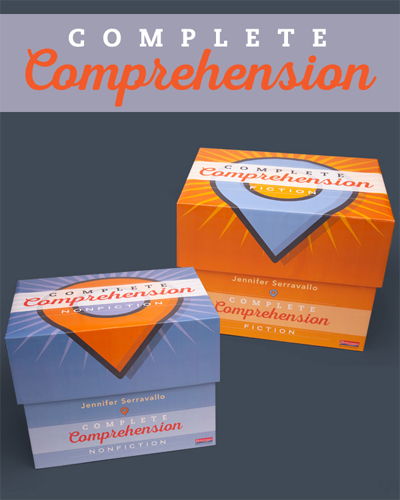
Conversations went from What am I going to teach next to I need to make sure students have access to these skills because this is what they’re ready for.
—Danielle, Director of Elementary Education
We never saw a resource like this which actually laid out in rubric form indicators of how a child would move through different reading levels.
—Laurie, Literacy Coach
I have all the data I need in terms of kids and them being excited about their reading and the light bulbs that go off as they read.
—Cliff, Elementary Principal
I wasn’t buying in right away, but once I saw the wealth of information that I got back, I was totally sold.
—Linda, 5th Grade Teacher
TEACHER’S GUIDE TO READING CONFERENCES
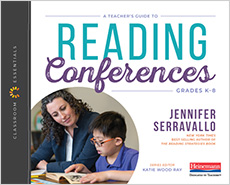
"If you are a reading teacher, a curriculum coach, or a school leader, order a copy of A Teacher’s Guide to Reading Conferences right now. It is a must-have resource for anyone who wants to up their teaching and learning game during independent reading time. The entire book is dedicated to helping teachers have quality conferences with readers."
—Rita Platt
Read the entire review at Middleweb
UNDERSTANDING TEXTS & READERS
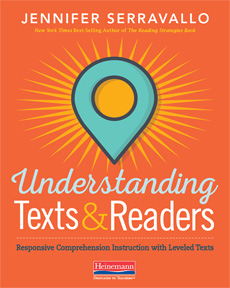
If you teach in a self-contained elementary school classroom, are a reading specialist or interventionist, teach special education, are a junior high or high school English language arts teacher, or a content teacher charged with integrating disciplinary literacy, you should read this book.
—Rita Platt
https://www.middleweb.com/39693/pair-just-right-texts-and-reading-strategies/
Simply amazing! Jennifer Serravallo outdid herself – again! Her new book, Understanding Texts & Readers: Responsive Comprehension Instruction with Leveled Texts, is one of the most teacher friendly books that I have read.
—Linda Biondi
https://www.middleweb.com/39448/building-comprehension-using-leveled-texts/
When I ask teachers in the future whose shoulders they're standing on after a particular lesson, I'm sure to hear Seravallo's name. And they'll be no doubt that she truly deserves the credit.
—Third and Rosedale
http://thirdandrosedale.blogspot.com/2018/09/standing-on-shoulders-of-giants.html
Where has this book been all my life? Understanding Texts and Readers feels like it pulls together everything Serravallo has been working on for the past several years into one clear, very understandable book. It’s definitely worth a book study with a team of teachers or even an entire school.
—Heather at Coaching, Teaching, Always Learning
http://coachingteachingalwayslearning.blogspot.com/2018/09/book-review-understanding-texts-and.html?spref=tw
Jennifer Serravallo has expanded on the research of many of the pillars of literacy when writing this book (Fountas & Pinnell are referenced often). But in true Serravallo fashion, she has approached a complex topic and made it teacher friendly, accessible, and has created a resource that teachers can turn to time and time again to help them better meet the needs of their students.
—Stacey Taylor, Teaching from the Left
https://teachingfromtheleft.blogspot.com/2018/09/review-of-understanding-texts-and.html
I hope all teachers of readers will get together with this book and have conversations that help us re-imagine the uses of leveled text, re-ignite a passion for teaching readers, and most of all re-engage in our understandings of what all the parts of a reading life entail. It is so many things. So many beautiful twists and turns. It is meant to be a journey with infinite destinations, and we are so lucky to be a part of it all.
—Besty Hubbard, Middle Grades Book Village
https://mgbookvillage.org/2018/09/26/a-review-of-understanding-texts-readers-a-giveaway/
Jennifer, we love your new book. Thank you for giving educators this resource. It is in our coaching bag and we can’t wait to explore it with teachers.
—Clare Landrigan, Teachers for Teachers
http://www.teachersforteachers.net/?p=16482
WRITING STRATEGIES BOOK
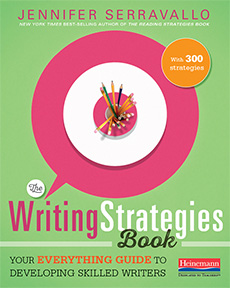
Thank you, thank you to Jennifer Serravallo and to Heinemann Publishing for this collection of powerful writing strategies. I cannot wait to engage in the work of growing thoughtful and empowered writers using this incredible resource.
—Valinda Kimmel
https://www.valindakimmel.com/everything-guide-developing-skilled-writers/
This book is already on the top of our stack of “go-to” professional resources and a book we will share with teachers in our partnership schools. It is simply that smart.
—Clare Landrigan, Teachers for Teachers
http://www.teachersforteachers.net/?p=4265
I read the introduction and then reread it. The first time I read it for enjoyment (yes, enjoyment) and the second time I practiced close reading, noting my questions, wonderings, and useful applications for the classroom. Thirty-two pages full of information, inspiration, and implementation of writing strategies – just in the introduction.
—Linda Biondi
https://www.middleweb.com/34874/everything-you-need-to-develop-writers/
Inside this new jam-packed resource book focused primarily on writing, Serravallo has organized over 300 useful writing strategies and lessons, and has helpfully coordinated them by grade, genre and “point in the writing process” so that an activity can easily be applied right away.
—Kevin Hodgson
https://www.middleweb.com/33787/easy-to-use-strategies-to-develop-young-writers/
I can assure you, this book will be finding its way into your classroom and making your workshop hum with a whole new tune
—Betsy Hubbard
https://twowritingteachers.org/2017/01/28/writing-strategies/
The Writing Strategies Book is true to its subtitle, Your Everything Guide to Developing Skilled Writers. It belongs on your desk right next to your plan book to provide a helping hand as you work to help children become skillful and willing writers.
—Russ Walsh
https://russonreading.blogspot.com/2017/01/the-writing-strategies-book-by-jennifer.html