By Jennifer Serravallo
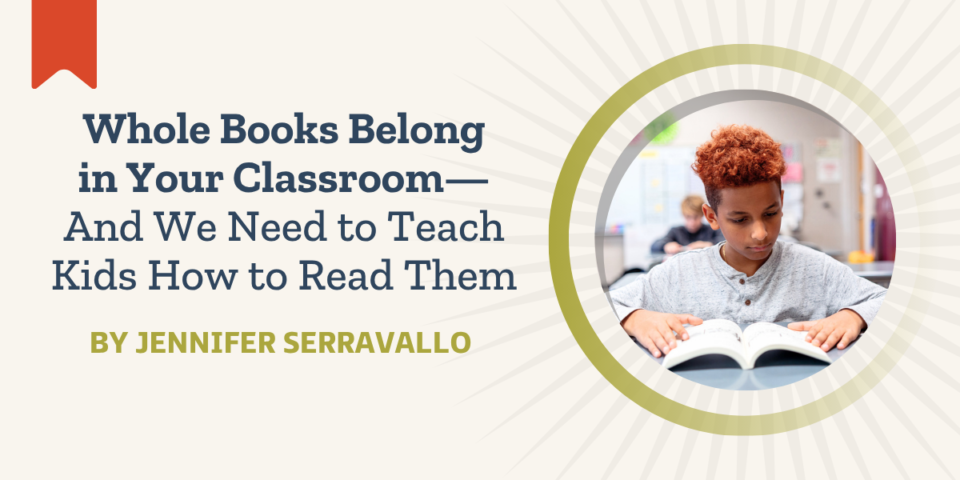
Whole books make different demands on readers than short texts like articles, excerpts, and short stories. If your reading program is exclusively, or mostly, built around short texts and the whole books have been shelved, it’s time to course-correct. We need to bring whole books back as a regular part of our literacy block, give students concrete strategies for how to read them with deep comprehension, and we need to support students through their experience in whole class and small group lessons.
Reading a Whole Book Is a Different Cognitive Experience
When a reader sits down with a chapter book, full-length novel, or multi-chapter information book, they're not simply doing more of the same thing they do with a passage or except; they're doing something qualitatively different. When a reader has to track characters, hold onto plot threads, remember what happened three chapters ago, and keep their place in the larger arc of a story — all while continuing to read forward — they are building and exercising cognitive capacities that a single passage simply cannot develop.
This hasn’t been studied enough, in my opinion, but here are a few with different-aged students that caught my attention:
- Mesmer and Heibert in 2015 investigated how text complexity and text length affect reading comprehension for third graders. They found that the text length negatively impacted both word reading and overall comprehension. The longer the text, the higher the rates of errors.
- Öksüz, Yaşartürk, and colleagues studied fourth-grade students, researchers found that sustained attention was a strong, independent predictor of reading comprehension, accounting for 35% of the variance in comprehension outcomes and that it mediated the relationship between working memory and understanding.
- In a 2019 study, Westbrook, Sutherland, Oakhill, and Sullivan tested what happened when teachers moved away from fragmented, excerpt-based instruction and instead had classes read whole novels at a brisk, sustained pace with teacher support in the form of comprehension strategies. The results were striking: students who read whole texts at a faster pace showed significantly better comprehension and engagement. So much better that the researchers reported that after three months of this kind of instruction, students made 8 to 16 months of growth. The same research team followed up with a 2023 pilot study developing an "immersive, faster read" approach specifically for struggling adolescent readers. Again, reading whole texts at a sustained pace, developed both comprehension and engagement (Westbrook, Oakhill, & Sullivan, 2023).
- Cognitive neuroscientist Maryanne Wolf has documented how the brain's "reading circuit" adapts to the kind of reading it practices most. Sustained engagement with longer texts develops capacities for analogical reasoning, deep inference, and empathy that skimming and scrolling do not. When students primarily consume short digital content, they may actually lose ground in their ability to read deeply because the brain is remarkably adaptive, and it will optimize for what it does most often (Wolf, 2018).
- Annisette and Lafreniere (2017) found that habitual consumption of short digital texts was significantly associated with reduced capacity and inclination for long-form reading even in adults. The habit of "going deep" has to be built, practiced, and protected.
Explicit Instruction for Whole Book Reading Comprehension
The research points clearly to a conclusion: students need whole books and they need explicit support in how to read them. Holding a text in mind across days and weeks, tracking characters and themes, sustaining attention and recovering when it wavers — these are skills. They need to be taught, not assumed.
Here are some strategies to get started:
- For tracking plot across a whole book, try Strategy 5.19 Record Each Chapter's Main Event. Students pause at the end of each chapter to jot a note or sketch of the key event connected to the central problem, giving them a running record to reference as they progress through the book.
- For managing shifts in setting, try Strategy 5.4 Think: Where Am I? Students slow down at the start of each chapter to use pictures and words to identify where and when the scene takes place, noticing visual cues and caption boxes that signal changes in place or time as they move through the book.
- For understanding how character relationships evolve, try Strategy 6.22 Analyze Character Relationships, where students track how specific characters interact across multiple scenes. They note qualities of and shifts in character relationships at each encounter, then use these observations to form a theory about the relationship over the course of the book.
- For understanding figurative language in context, try Strategy 11.22 Stick to Your Story, where students identify the type of figurative language they have encountered— such as a metaphor, hyperbole, or idiom—and use their knowledge of that type, along with surrounding context, to figure out the author's intended meaning.
- For noticing multiple themes across a story, try Strategy 7.19 Find Different Themes in Different Plotlines. Students to track each character's changes, obstacles, and resolutions across separate plotlines, then identify a theme for each one.
- To figure out main ideas within and across sections of a longer informational text, try Strategy 8.17 Consider Shifting Structures. Students pause after each chunk of text to identify its structure and jot a main idea, then look back across their notes to piece together one overarching main idea.
- To manage information and determine key details across two related topics, try Strategy 9.14 Categorize to Compare. Students organize information into categories as they read, then use those categories to compare two related topics within the same book or across a text set.
Strategies like these can be taught during whole class instruction (read aloud, close reading, shared reading), or small group instruction (book clubs, focus lessons).
Excerpts and passages don’t need to disappear, but they can’t be the whole story. When we give students whole books and teach them how to navigate them—strategically, confidently, with increasing stamina—we give them access to a kind of reading that can genuinely change how they think, engage, and whether they have the skill and will to pick up whole books on their own outside of school.
Jennifer Serravallo is the author of The Reading Strategies Book 2.0. Her latest work, Whole Book Comprehension, is a grade-level supplemental curriculum resource for grades 1–6, releasing this November. Interested in learning more about Whole Book Comprehension? Fill out this form to stay informed as more details become available.
References
Annisette, L. E., & Lafreniere, K. D. (2017). Social media, texting, and personality: A test of the shallowing hypothesis. Personality and Individual Differences, 115, 154–158.
Mesmer, H. A., & Hiebert, E. H. (2015). Third graders’ reading proficiency reading texts varying in complexity and length: responses of students in an urban, high-needs school. Journal of Literacy Research, 47(4), 473–504.
Öksüz, H.I., Yaşartürk, I., Yildiz, M., Arici, E.Y., Sotiopoulos, D., and Kalogiannakis M. (2025). Sustained attention as a cognitive bridge between memory and reading comprehension in primary school students. Reading Psychology, 47(2)
Westbrook, J., Oakhill, J., & Sullivan, S. (2023). An immersive, 'faster read': A pilot, mixed-method study developing whole-text reading comprehension and engagement with adolescent struggling readers. Research Papers in Education, 38(6), 774–796.
Westbrook, J., Sutherland, J., Oakhill, J., & Sullivan, S. (2019). 'Just reading': The impact of a faster pace of reading narratives on the comprehension of poorer adolescent readers in English classrooms. Literacy, 52(1), 44–54.
Wolf, M. (2018). Reader, come home: The reading brain in a digital world. Harper.

Jennifer Serravallo is the author ofThe New York Times' bestselling The Reading Strategies Book 2.0 and The Writing Strategies Book. These and some of her other titles have been translated into Spanish, French, Italian, and Chinese. Her popular books and resources help teachers make goal-directed, responsive, explicit strategy instruction doable in every classroom. Her newest titles are The Reading Strategies Book 2.0; Teaching Writing in Small Groups; A Teacher’s Guide to Reading Conferences, and the assessment and teaching resource Complete Comprehension for Fiction and Nonfiction.
Jen is a frequently invited speaker at national and regional conferences. She and her team of literacy specialists travel throughout the US and Canada to provide full-day workshops and to work with teachers and students in classrooms. She and her team are also experienced online educators who regularly offer live webinar series and full-day online workshops.
Jen began her career in education as an NYC public school teacher. Now as a consultant, she has spent the last twenty+ years helping teachers across the country create literacy classrooms where students are joyfully engaged, and the instruction is meaningfully individualized to students' goals. Jen served as a member of Parents Magazine Board of Advisors for education and literacy, and is on the NYC Reads Advisory Council as the city works to bring Science of Reading, Writing, and Learning-based practices to every classroom.
Jen holds a BA from Vassar College and an MA from Teachers College, where she has also taught graduate and undergraduate classes.
Learn more about Jen and her work at Hein.pub/serravallo, on Twitter @jserravallo, or Instagram @jenniferserravallo.