For decades, reading instruction rested on a simple idea: match every student to a text at their precise reading level, not too hard, not too easy. It made intuitive sense.
But research tells a different story. There’s no evidence this leveling approach optimizes learning (Shanahan, 2025). When researchers taught students with more challenging grade-level texts instead of their supposed instructional level, kids learned just as well or better (Morgan et al., 2000; O’Connor et al., 2010), and schools with the greatest achievement gains tend to do exactly that (TNTP, 2024).
This matters most for students who read below grade level. Left with only the books they can handle alone, they never access the grade-level vocabulary, language, and ideas that would help them grow. There are many ways to make sure every student can access them; here are three key ones to start with.
1. Decide how students will read
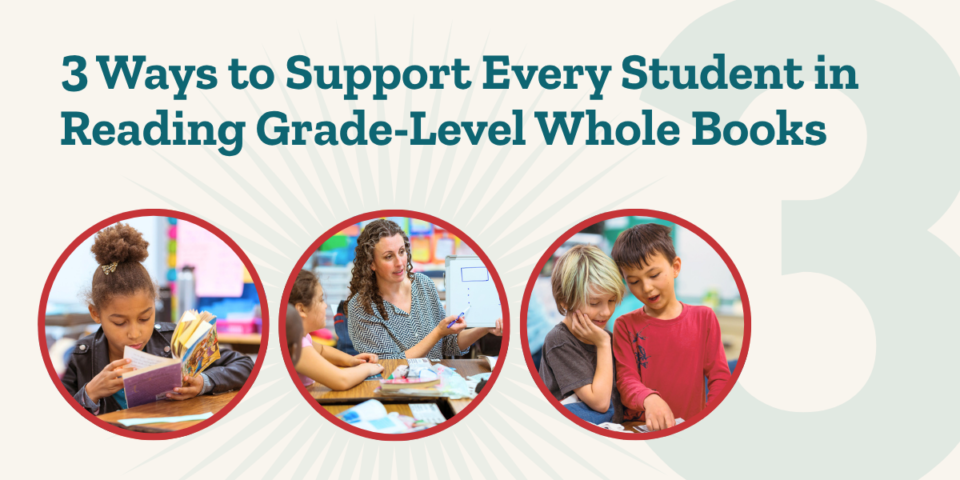
Plan whether you’ll read the text to students (read aloud), with them (shared or close reading), or have them read it by themselves, independently or in pairs. “To” offers the most support, “by” the least, so choose based on how much scaffolding students need, what will engage them, and which skills and strategies you want to teach. None of this is all-or-nothing: you might read aloud early in the book, then hand off more independence as students get a feel for the setting and vocabulary, or shift within a single lesson if you sense they need more support mid-page.
This flexibility is what makes a grade-level text accessible to a reader who couldn’t access it alone. A student reading below grade level can still fully experience a grade-level book, its ideas, its language, its story, when you support them with read-aloud or shared reading, then gradually shift responsibility as skill and familiarity grow.
2. Teach the how-to behind comprehension
A reading strategy is a step-by-step procedure: naming what to notice, what to ask yourself, and what to do with what you find (Afflerbach et al., 2011). When you make a strategy explicit, naming the steps, modeling them by thinking aloud, then guiding students through them, you turn the invisible work of reading into something visible and learnable (Pressley & Afflerbach, 1995; Shanahan et al., 2010). Most lessons only need one or two, whether newly taught or revisited for more practice, aimed at whatever the text calls for: tracking a character’s growth, following the plot, uncovering an argument’s evidence, or noticing figurative language.
For a student who can’t yet read grade-level text independently, strategies are the bridge to real understanding. Explicit modeling gives them a way in even when the text is a stretch, so they build comprehension skills alongside grade-level content.
3. Build in time to talk about the book
Talk is one of the most powerful, and most overlooked, tools for building comprehension. Students who talk more about what they’re reading, in pairs, small groups, or as a whole class, understand more, feel more confident as readers, and pick up richer language and vocabulary (Wilkinson et al., 2015). Conversation does double duty for you, too: it’s a chance to teach speaking and listening skills, and a window into what students actually understand, since their thinking becomes audible.
But conversation doesn’t just happen. Kids need to be taught how to talk about books, the same way they’re taught how to read them (Zwiers & Crawford, 2009). Plan for it when students will have something to say, maybe after a few reading responses or several chapters, and vary how you organize it: partners, small groups, or the whole class.
For below-grade-level readers, conversation offers a way to process grade-level ideas out loud, with peers. Comprehension and conversation build each other (McKeown & Beck, 2015), so talk is often where their understanding catches up to the text.
Bringing it together
None of these strategies require watering down the text. Read-aloud and shared reading carry students through the words, explicit strategy instruction shows them how to think about what they read, and conversation gives that thinking somewhere to go. They aren’t the only ways to support readers with grade-level books, just three key places to start. Together, they’re how every student, not just those already reading independently on grade level, gets real access to grade-level books.

Jennifer Serravallo is the author of more than two dozen bestselling literacy resources for teachers. Her newest series, Whole Book Comprehension for Grades 1–6, is due out this fall. Each grade-level kit includes eight whole books, four fiction and four nonfiction titles, along with lesson-by-lesson guidance, rubrics, strategies, and conversation scaffolds for teaching them.
References
Afflerbach, P., Pearson, P. D., & Paris, S. G. (2011). Clarifying differences between reading skills and reading strategies. The Reading Teacher, 61(5), 364–373.
McKeown, M. G., & Beck, I. L. (2015). Effective classroom talk is reading comprehension instruction. In L. B. Resnick, C. S. C. Asterhan, & S. N. Clarke (Eds.), Socializing intelligence through academic talk and dialogue (pp. 51–62). American Educational Research Association.
Morgan, A., Wilcox, B. R., & Eldredge, J. L. (2000). Effect of difficulty levels on second-grade delayed readers using dyad reading. The Journal of Educational Research, 94(2), 113–119.
The New Teacher Project (TNTP). (2024, September 25). The opportunity makers: How a diverse group of public schools helps students catch up—and how far more can. https://tntp.org/publication/the-opportunity-makers/
O’Connor, R. E., Swanson, H. L., & Geraghty, C. (2010). Improvement in reading rate under independent and difficult text levels: Influences on word and comprehension skills. Journal of Educational Psychology, 102(1), 1–19.
Pressley, M., & Afflerbach, P. (1995). Verbal protocols of reading: The nature of constructively responsive reading. Erlbaum.
Shanahan, T. (2025). Leveled reading, leveled lives: How students’ reading achievement has been held back and what we can do about it. Harvard Education Press.
Shanahan, T., Callison, K., Carriere, C., Duke, N. K., Pearson, P. D., Schatschneider, C., & Torgesen, J. (2010). Improving reading comprehension in kindergarten through 3rd grade: A practice guide (NCEE 2010-4038). National Center for Education Evaluation and Regional Assistance, Institute of Education Sciences, U.S. Department of Education.
Wilkinson, I. A. G., Murphy, P. K., & Binici, S. (2015). Dialogue-intensive pedagogies for promoting reading comprehension: What we know, what we need to know. In L. B. Resnick, C. A. Asterhan, & S. N. Clarke (Eds.), Socializing intelligence through academic talk and dialogue (pp. 37–50). American Educational Research Association.
Zwiers, J., & Crawford, M. (2009). How to start academic conversations. Educational Leadership, 66(7), 70–73.