by Jennifer Scoggin & Hannah Schneewind, the authors of Trusting Readers.
Reading for pleasure, also known as volitional reading, is defined as any kind of reading done for enjoyment or purposes other than work or school. A recent report found that daily reading for pleasure in the United States has declined by more than 40% over the last 20 years (Bone et.al). One way to address this issue is to start with our youngest readers, making sure that they have numerous positive experiences with reading whole books. What does “whole book reading” mean for emergent readers? How might you incorporate whole book reading into your day, regardless of the literacy program you are using?
What is the role of the teacher during whole book reading?
Whole book reading goes well when the teacher intentionally sets the stage for it. To provide joyful experiences that inspire children to want to read, conduct daily read alouds in a variety of genres. Invite the entire class to chime in during shared reading -Big Books, songs, and poems-that children can then read on their own.
Set clear routines that make independent reading time go smoothly, such as routines for picking books, finding a quiet place to read, what to do when you think you have finished a book, and how to keep yourself reading when you get distracted. Based on the needs of the class, provide concise whole class lessons before children start to read that reinforce previously taught skills, prompting children to apply those skills while reading. And of course, provide students with tailored 1:1 feedback. Skillful feedback supports students as they internalize relevant skills and strategies, moving toward independence (Afflerbach, 2022) , motivates learning (Narciss & Huth, 2004) and enhances learning and performance (Shute, 2008). This is the ideal time to connect with your readers individually.
What does high quality whole book reading look like in K-2?
Whole book reading takes a variety of forms and looks different depending on your purpose. Shared Reading gives children the chance to focus on decoding, fluency, and comprehension and the fun of reading something together. Read alouds give all children the opportunity to experience whole books that they may not be able to read on their own.
If you want to give children the opportunity to practice decoding and fluency on their own, children can reread decodable texts, books that they have read with you in small groups, or familiar shared poems. If you want to give children the chance to explore new books, children might pick books from the classroom library that they are able to read on their own or discover nonfiction books that match their interests. Depending on your schedule on a given day, this reading time can be for as little as 5 minutes to as long as 20 minutes. You can direct children as to whether it is a day to reread familiar books or explore new ones, a day to read by themselves or with a partner. Remember that this time is not replacing explicit instruction; it complements it.
What are the benefits?
The clearest, immediate benefit is the uptick in engagement that you will observe. Children will ask you, “When are we reading the next chapter?” “We need to finish the picture book from yesterday that we didn’t get to finish because of the fire drill!” and “May I please read this book now?” Children will stand at the Big Book easel with the pointer, giggling as they pretend to be the teacher. They will discover that they are able to read a book on their own.
We are in charge of teaching not just reading, but also teaching readers (Afflerbach, 2022). Of course we need to teach reading-foundational skills, and strategies related to phonemic awareness, phonics, fluency, vocabulary, and comprehension. We also need to teach readers- the child themselves, their feelings about themselves as a reader, their feelings about reading, their level of confidence in themselves, and their engagement in and motivation to read. When we attend to a student's emotions and experiences, they are more likely to grow as readers.
Students cannot become better at something they are rarely given the opportunity to do. If we are genuinely concerned about older students’ ability to sustain attention through an entire novel, then we must start to focus on this early on. We need to teach our youngest readers not only how to read, but how to stay with and enjoy books—to laugh, to share gross parts of a nonfiction book with their friends, to gasp when a beloved character makes a bad decision.
Every time we invite a child to read, we are sending them a message:
“You’re a reader.”
What are the consequences of not providing time for whole book reading?
In order to find reading joyful, children need to put their newly found skills to work in authentic texts. Duke, Ward, and Pearson (2021) argue that reading comprehension develops through a layered and integrated approach. Foundational word-reading skills are essential, but they are not sufficient; effective instruction also provides sustained opportunities for students to engage meaningfully with texts. Children who experience an overdose of one type of instruction in isolation may become disenchanted with reading early on and may develop a negative attitude towards reading.
Horowitch’s (2024) reporting on college students who struggle to read entire books highlights another consequence. Students cannot become readers who can sustain attention through a long, complex text if they have had few opportunities to do so.
Time to read in school is also an equity issue. Neuman and Moland (2019) found stark disparities in children's access to print in neighborhoods experiencing concentrated poverty, describing these communities as “book deserts.” When children have limited access to books at home, we need to provide access to books in school. Not doing so runs the risk of perpetuating existing opportunity gaps.
When can I do it?
You can fit in this reading time in a variety of ways. First, look at your reading program. Some programs include independent reading as part of the daily lesson. If your program does not, try starting or ending the literacy block with a few minutes of reading time. You can incorporate read aloud into morning meeting, during social studies, science, or SEL, or after lunch to ease back into the classroom. Shared Reading can fit into phonics or word work time.
Why Cover to Cover Reading Matters
You focus on teaching your students strong foundational skills so that they can become proficient and confident readers. You also can give them the opportunity to continue to grow by providing them with regular time to read. While this time of day is not the centerpiece of your literacy block, you can provide time for students to read, a library from which they can choose books, and your instructional expertise. This reading time provides opportunities for the implicit learning that must take over from explicit instruction if students are to become independent, motivated learners (Seidenberg, 2024). If we never give children the time to enjoy reading or listening to an entire book, how can we expect children to want to do this as texts get more challenging? Teaching the skills needed to become a proficient reader while fostering a love of reading is one way to reverse the decline in reading for pleasure.
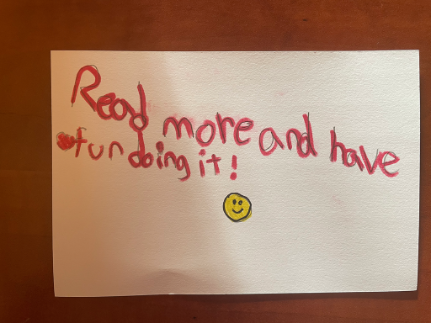
In the words of a first grader, children want to:
Citations
Afflerbach, P. (2022). Teaching readers (not reading): Moving beyond skills and strategies to reader-focused instruction. Guilford Press.
Bone, J. K., Bu, F., Sonke, J. K., & Fancourt, D. (2025). The decline in reading for pleasure over 20 years of the American Time Use Survey. iScience, 28(9), Article 113288. https://doi.org/10.1016/j.isci.2025.113288
Bus, A. G., Shang, Y., & Roskos, K. (2024). Building a stronger case for independent reading at school. AERA Open, 10.
Clark, A. M., Anderson, R. C., Kuo, L.-J., Kim, I.-H., Archodidou, A., & Nguyen-Jahiel, K. (2003). Collaborative reasoning: Expanding ways for children to talk and think in school. Educational Psychology Review, 15(2), 181–198. https://doi.org/10.1023/A:1023429214229
Duke, N.K., Ward, A.E., & Pearson, P.D. (2021). The Science of Reading Comprehension Instruction. Read Teach, 74(6), 663–672.https://doi.org/10.1002/trtr.1993
Horowitch, R. (2024, September 3). The elite college students who can’t read books. The Atlantic.
Neuman, S. B., & Moland, N. (2019). Book Deserts: The Consequences of Income Segregation on Children’s Access to Print. Urban Education, 54(1), 126-147. https://doi.org/10.1177/0042085916654525

Dr. Jennifer Scoggin has been a teacher, author, speaker, curriculum writer, and literacy consultant. Jennifer’s interest in the evolving identities of both students and teachers and her growing obsession with children’s literature led her to and informs her work.
Jen began her career teaching first and second grades in Harlem, New York. In her current role as a literacy consultant, Jennifer collaborates with teachers to create engaging literacy opportunities for children. She holds a doctorate in curriculum and instruction from Teachers College, Columbia University and has previously published two books about literacy instruction and life in the classroom.
With Hannah Schneewind, Jen is the co-creator of Trusting Readers, a group dedicated to collaborating with teachers to design literacy opportunities that invite all students to be engaged and to thrive as readers and writers.
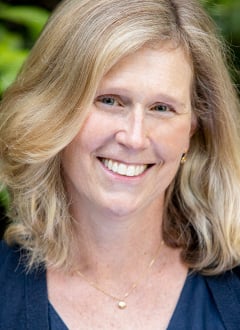
Hannah Schneewind has been a teacher, staff developer, curriculum writer, keynote speaker and national literacy consultant. She brings with her over 25 years of experience to the education world. Hannah’s interest in student and teacher agency and her belief in the power of books informs her work with schools.
Hannah began her career as a first grade teacher at P.S. 321 in Brooklyn, New York, and her classroom was used as a model classroom for teachers around the city and country. The trust the administrators placed in her along with the culture of collaboration in the school formed her beliefs in the power and possibilities of schools.
With Jennifer Scoggin, Hannah is the co-creator of Trusting Readers, a group dedicated to collaborating with teachers to design literacy opportunities that invite all students to be engaged and to thrive as readers and writers.
You can connect with them at @TrustingReaders