Adapted from Wendy Ward Hoffer’s All Minds on Mathematics.
In the context of math work time, opportunities to exchange ideas, either between partners, teams, or among the whole class can punctuate work time and provide a flow from one layer of challenge to the next. Creating opportunities for students to justify their thinking promotes equity because it invites learners to make sense for themselves and others in novel ways, allowing access to a range of mathematical explanations.
Structures for Academic Talk
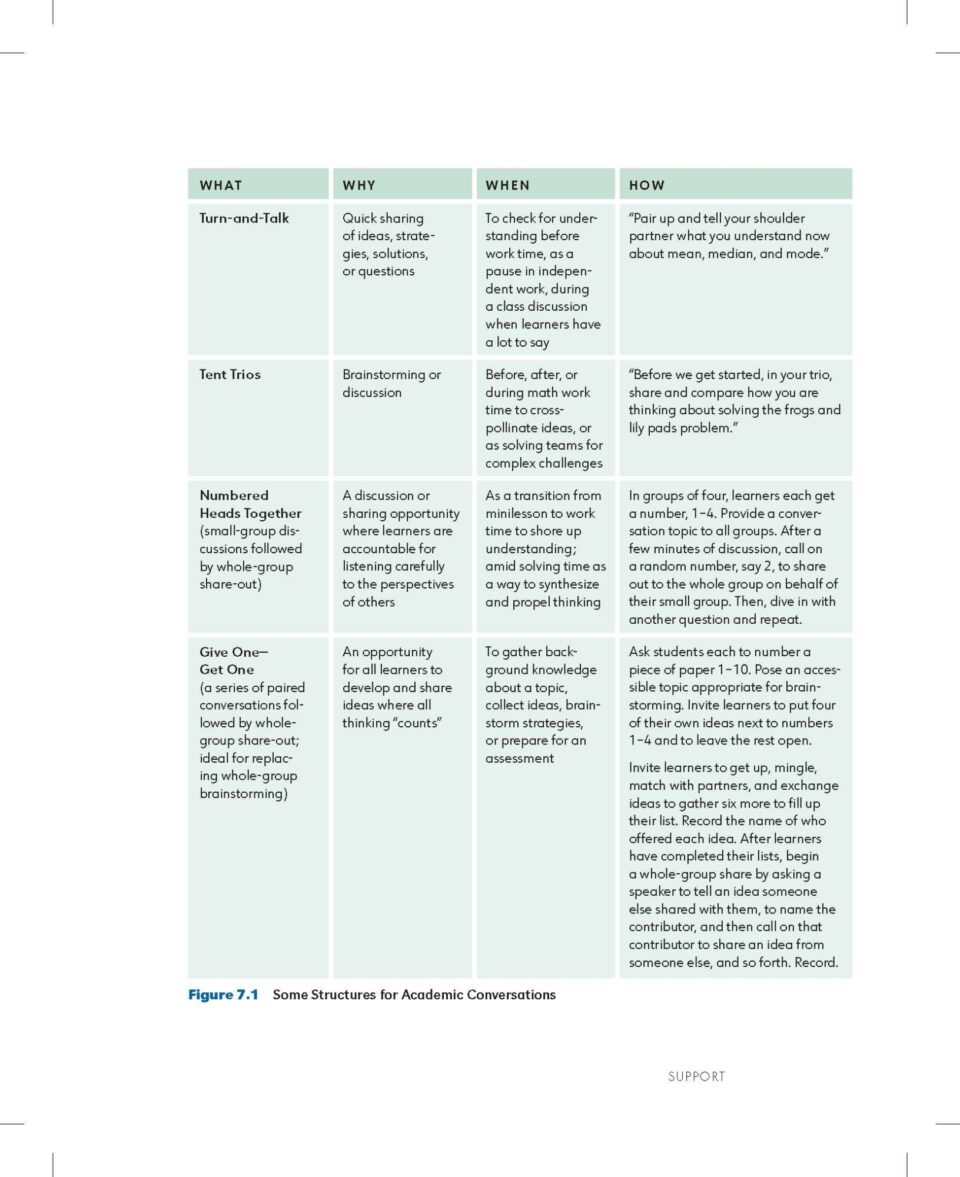
There are numerous fun structures for academic conversations—everything from pair and share to tent trios to wagon wheels, which are all excellent, if well-facilitated. You may have several in your back pocket already, which is terrific, and you only need a few because, deployed well, the structure will matter less than the content learners are exploring.
Teaching Academic Talk
Some teachers don’t like to break for turn-and-talks or any other free-range conversation among learners, often because students have, in the past, used these opportunities as distractions from the learning at hand. Given the high return on investment that student conversations generate, we can make intentional efforts to teach students the skills and responsibilities of this support structure by preparing them well for these talks, holding them accountable during, and reflecting together afterward.
BEFORE CONVERSATIONS
- Match the conversation structure to the purpose.
- Explain the norms and expectations.
- Help students prepare for the conversation by reading, thinking, writing, solving, drawing, or otherwise gathering their own ideas.
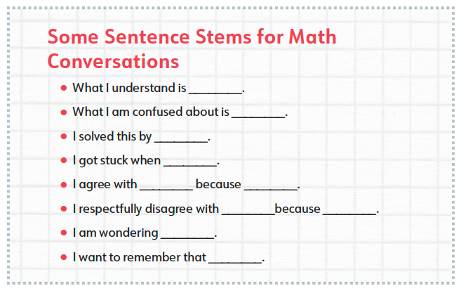
- Provide sentence stems (see next page).
- Model how the conversation will look and sound.
DURING
- Provide and stick with time limits.
- Move among students.
- Confer and coach.
- Notice and name positive participation.
- Stop and reset if needed.
AFTER
- • Ask learners to share what they talked about.
- • Provide feedback on what you observed.
- • Invite reflection on the impacts of their conversations.
- • Make notes for yourself on facilitation ideas for next time.
As described by the California Department of Education, State Math Framework, taking time to reflect with students on the efficacy of their collaboration helps learners own the responsibility for productive group work in service of mathematical understanding. Prompts for discussion might include:
- How did your group support you as a mathematician today?
- In what ways did you support the understanding of others?
- What were your groups’ strengths and challenges?
- What did you learn about collaboration that you want to remember?
Conversations of this nature not only help students recognize their power as collaborators but also inform us of their perceptions of the experiences and their areas of growth, which we can address in future lesson designs.
Reflection: What are your go-to structures for student conversation? What new approaches might you try in your facilitation?