Adapted from You Already Know by José Luis Vilson.
I now know that a crucial part of my work as a math teacher isn’t teaching the math itself. It’s helping students believe that they can do math. There was a time when I was focused on sorting out the tension between different pedagogical stances. Was direct teaching or exploratory teaching the most effective approach? Which of these methods proved more effective at achievement on standardized tests? Is the standardized test the most important measure of attending to student learning? Do students aspire to become better-informed citizens or better test takers? Every few months, a new article came out urging teachers to change their practice with unbridled confidence but without a clear rationale other than “because someone more powerful than you told you so.” In some ways, administrators, education professors, and other professional development providers only left me with more questions about my internal arguments on best math teaching practices.
We were also in an era of market-based solutions that paved the way for schools, particularly those with more students of color in impoverished conditions, to go from a pedagogical trial-and-error approach to a trial-and-failure approach. If students failed, a storm of accountability would rain on teachers individually and collectively. Education policy based on fear of reprisal undermined the ostensibly altruistic motives of a slogan like “No Child Left Behind.” It eroded the reasons that led someone like me to choose to go to a school that was under resourced, over scrutinized and consistently threatened with closure. The country wasn’t ready for a nuanced conversation about this drive toward punitive accountability, either. In actuality, it was possible to critique teachers who needed the support and motivation to improve without belittling the entire teaching profession for doing much more with increasingly less.
If that’s the message teachers across the nation felt, the students in schools like the ones where I taught felt this tension exponentially. My students often came to my classroom with a depressed level of confidence in their mathematical abilities. They’d initially scoff at the idea that they were good at math. The compliant students would plod through the sets of problems while the more vocal students would cry, “Why are we doing this anyway?” In my first years, I came up with some rationales, ranging from wholesome to ridiculous:
- Because math is great.
- This is going to help you later in life!
- It’s so much fun when you try it!
- You wanna get robbed?
Admittedly, I had some reflecting to do. Of course, I would never advocate on behalf of larcenists—our school systems did enough of this, particularly stealing students’ academic identity formation. Even the honors students often received messages from multiple sides about the limits to their intellectual capabilities. They had teachers and principals who believed they “wouldn’t amount to nothin’” when they were just trying to work toward making some money in the future to feed their families. Their families—often victims of inadequate schooling themselves—would excuse their children’s lack of mathematical aptitude with “Well, I wasn’t a math person either, so that’s fine.” Society sent the same messages about math, too. My students didn’t see themselves in the stereotypical nerdy math students shown in mass media. But I also argue that white and Asian students who saw these stereotypes got hurt by them as well. These academic myths kept many people from understanding why math mattered until much later in life.
What Do We Already Know?
The cynical part of me would point to how the axioms of even our most basic math rest on the notion of identity. When we add a number with zero, we expect the same number to return to us. When we multiply the number 1 with another number, even if it’s a variable, we know we get the same number back. The identity properties of addition, multiplication, and so forth are no different from the philosophical questions of why we are human beings and how we know. If this were a presentation, I would show the GIF of rapper Cardi B in court pointing and pursing her lips to point out the self-evident nature of this argument.
The serious part of me would say that, for people who fully understand the triumvirate of pedagogy, curriculum, and assessment, the math we do only goes as far as the humans who do it. If math as a field is a reflection of humans interpreting their experiences with the world through patterns and shapes, then our identities provide the lenses and tints that inform that reflection. This seems like a stretch for people who’ve only been taught to see math as a set of isolated standards in a sterilized environment, but for those who aspire to connection, relevance, and shared humanity, we know there are personal and community-based experiences that inform mathematical attitudes and aptitudes.
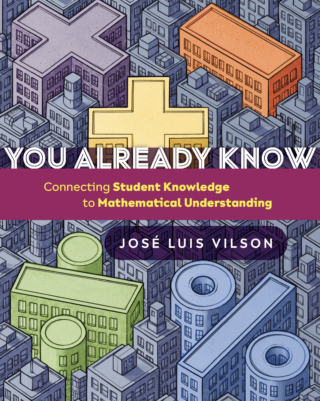
Math instruction doesn’t have to begin with what students are missing. It can begin with what they already know.
In You Already Know, veteran educator José Luis Vilson offers a practical, classroom-tested framework for helping students build confidence, deepen conceptual understanding, and see themselves as capable mathematical thinkers. Drawing on more than fifteen years of teaching experience, Vilson demonstrates how responsive math instruction can transform disengagement into curiosity and compliance into meaningful learning.