Adapted from José Luis Vilson’s You Already Know.
In 2010, a famous TED Talk by my good friend and educator Diana Laufenberg (who I also met via Twitter) garnered over two million views by extolling the virtues of failure as part of the learning process.
“We deal right now in the educational landscape with an infatuation with the culture of one right answer that can be properly bubbled on the average multiple-choice test, and I am here to share with you: it is not learning. That is the absolute wrong thing to ask, to tell kids to never be wrong. To ask them to always have the right answer doesn’t allow them to learn. So we did this project, and this is one of the artifacts of the project. I almost never show them off because of the issue of the idea of failure.” (Laufenberg 2010)
This idea of failure as learning has roots in different movements, especially in the progressive education space. At the time, Laufenberg worked at Philadelphia’s Science Leadership Academy, which permits everyone in the building to think more expansively about their schooling experience. Flexible schedules, open projects, and healthy debate are just some of the markers of this school.
While this feels like a dream, educators who work there have told me that while they’re appreciative of the space, they work hard to make this happen and push against multiple societal and structural forces along the way. In addition to the pressure to perform, we have a societal frame for what we collectively want to see in teachers. We want teachers to think creatively, but not so differently from how we were taught. We’re happy to hear about innovation, but only if the classrooms look similar to how we imagine a classroom. Observers may cringe at any deviation from that image, or at least need a long explanation for the experimentation.
In schools like the one I worked in and the plethora I’ve visited, such experimentation would lead to heightened scrutiny. Professional judgment only extends as far as our collective imagination believes that a teacher, in fact, merits professional status. In many ways, the technocratic approach to education over the last two to three decades has narrowed the amount of “mistakes” schools feel they can make via thoughtful experimentation. While some may have had good intentions by limiting “bad teaching” from schools, they may have also limited the prospects to try new things that lead to stronger benefits over time. In other words, the constant fear of failure had a suppressing effect on the innovation that policymakers and high-level administrators sought.
If that’s what it’s like for teachers and principals, the pressure felt multifold for students. Rather than finding ways to leverage mistakes for more learning, our current system still pushes students to make as few mistakes as possible to their detriment. This also creates worse conditions for learning, and stigmatizes students’ capacity for learning across the board. Laufenberg’s talk pushes us to consider the courage to let students correct mistakes or, at least, make better ones.
This is especially true when it comes to the structures we consistently use in math. Critics of experimental math might say: “The approach I learned is the only way to get the answer. If it’s not broke, then don’t try to fix it.” But that’s not how mathematicians who love math think about their work. Some of the world’s most famous mathematicians and scientists often tinker at the edges or mix up the processes they undertake to uncover new learning. Yes, math has a certain set of axioms that we all abide by, but just beyond those basic rules is a whole field of math waiting to be proven, with undone experiments, and ways of knowledge we haven’t tapped into. We can’t get there without appreciating where we’ve been, where we are, and, particularly what we did that didn’t work and why for a particular goal. In this way, failures are lessons.
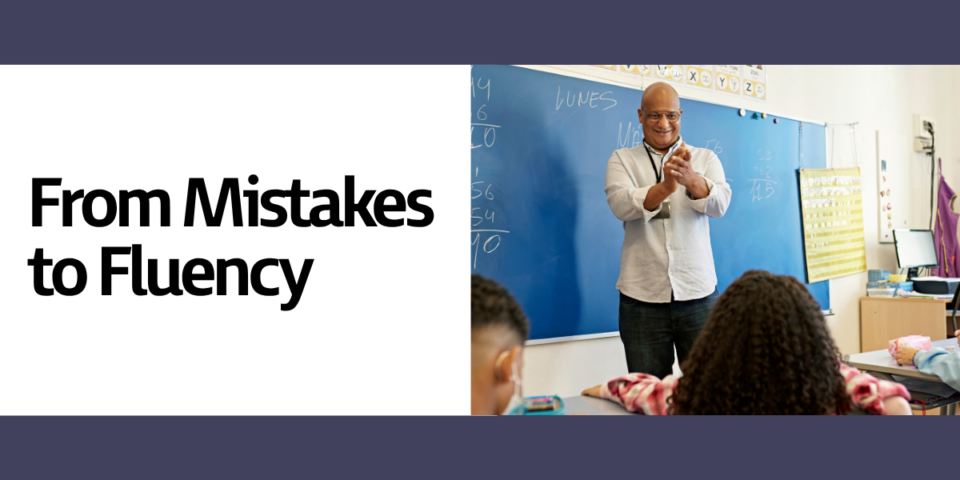
Mistakes don’t have to come from students, either. In the first few weeks of teaching, I like to make obvious mistakes in my lessons to see if students are willing to correct me. This almost never happens on the first try. Usually, after ten minutes, I’ll say “So, did anyone notice what I did?” No one will respond. “So, you all know that 11 + 17 = 28, but you let me write 30. Why?” Then a student will inevitably say, “I knew that was wrong, but I didn’t know we could respond about this . . .” Maybe they are accustomed to not correcting the teacher for a variety of reasons, but I dissuade them from silence immediately. “Hey, I’m here to teach, but I learn as much from you as you do from me. Next time, feel free to—respectfully—correct me when you see mistakes.” It opens them up to do other things, like struggling openly in front of me, teaching each other, and asking more questions. Jokingly, a couple of classes take liberties in correcting everything I do, but that comes with teaching middle school as well.
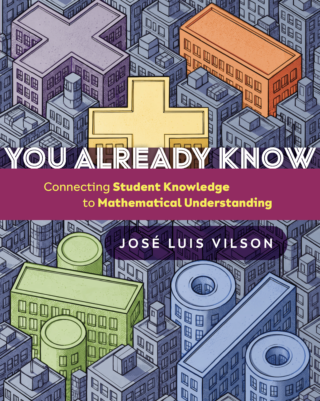
In You Already Know, José Luis Vilson shows teachers how to surface students’ existing knowledge and use it as the foundation for deeper, more engaging math learning. Practical, flexible, and immediately usable, this book offers a responsive approach to math instruction that helps students build confidence, take risks, and see themselves as mathematical thinkers.