Adapted from You Already Know by José Vilson.
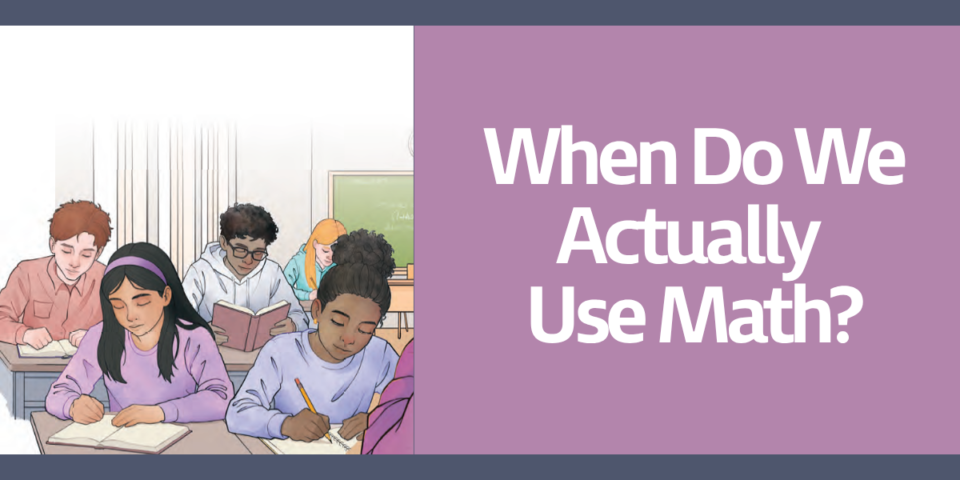
In the beginning of my fourth year of teaching, Olandria asked me, “Mr. Vilson, when are we ever going to use this?” We were learning about combining like terms. At the time, I wanted to wield a typical middle school teacher answer: “Throughout your life! You don’t even know . . .” I probably went on for another few minutes addressing one student’s inquiry and turned it into a mini lecture in case other students had a similar question. After I took a second to really think about Olandria’s question, I said, “You know what? You may not use it in your ‘real life,’ but it’ll be useful as you move through high school.”
That seemed to satisfy her line of inquisition (not inquiry), but it didn’t satisfy mine. Over time, I started to notice patterns not just in her questions but also in other students’. By the end of the year, I finally had the eureka moment so many of us crave. Her questions didn’t come from a source of laziness, contempt, or a lack of grit, as so many hypothesize. It came from a genuine source of frustration from wanting to do well. For students like her, she would rather question whole learning paradigms than conform to someone else’s way of thinking to “get it.”
In other words, she needed a path to understanding without my hand-holding. The more I insisted on her using my path, the more she openly resisted. As I did my first year, I had to get out of my own head and help her make connections to the material. I didn’t have words for it at the moment, but my logic made sense. No matter how abstract or convoluted the math, I only heard questions about the usefulness of learning the math when students felt little to no grounding with the work in front of them.
In that moment, I had to give myself permission to go beyond what I thought I knew. As I say time and again throughout the book: we don’t teach math; we teach students math. The former phrase is a convenient stand-in for the latter. By year four, I had a strong understanding of the standards, even as the curriculum swiftly changed underneath us. Even so, the students and their ways of processing felt less like buckets to fill and more like puzzle pieces to organize. To add a little more spice, the puzzle pieces changed shape almost daily. I definitely knew what the puzzle should look like, but the daily challenge remained to put all those pieces together. (Sometimes the game feels less like a puzzle and more like Jenga, but that’s for another book!)
Olandria was right to an extent. As we speak, policymakers, researchers, and educators alike openly debate math content across PK–12. Some have argued that we should focus on the four basic math operations and on traditional methods (I disagree!). Others have argued for specialized math teachers in the tested grades instead of elementary school generalists teaching those classes (I’d like to see more before giving a definitive answer here). While some of the debates persist, it can create an analysis paralysis where we can think neither in the long nor short term about what our students need for their math learning.
This all speaks to how our society has done a great job of illustrating the importance of mathematics but not the interconnectivity of math. Some of the math we do has little relevance with the majority of career-related skills, unless you’re moving into technical fields like engineering or architecture, and then geometry can be useful. Yet, rendering a skill useful because of its proximity to capital or labor feels mediocre. Across cultures, we see strong strands of knowledgeable people who’ve prized intellect paired with genuine curiosity about the world as strong character traits. Math as a field elevates this well. Really, in many of the problems we do in our classes, the process matters as much as the result. These processes, many of them outlined in our “practice standards,” provide a blueprint for how to approach problems through life, not just the ones in our math classes. What would it mean for our world if people made sense of problems and persevered in solving them? Where else do we attend to precision or look for and express regularity in repeated reasoning?
In many ways, our students already come with levels of resilience and observation skills that we don’t recognize. We have the opportunity to help students build the connective tissue with and for students and the math they deserve. The middle school curriculum serves as the ramp toward higher-order math. Preparing students for algebra and beyond requires less prescriptive and regimented pedagogy and more attention to how students see themselves in their work. It’s more about seeing phenomena (we call them problems) and organizing our thoughts about how we’ll better understand them. We build up students’ tool kits for understanding these phenomena and push them to use what they already know and go far beyond what they imagined they could.
Math is always something our students will use. Even if it’s not exactly the math we’re teaching them, it’s how they go about it that counts.
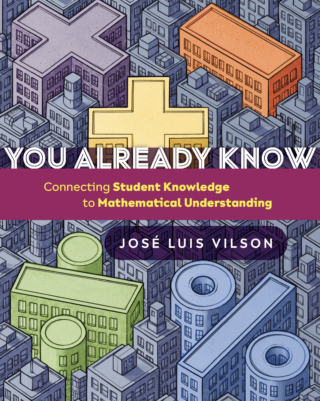
Math instruction doesn’t have to begin with what students are missing. It can begin with what they already know.
In You Already Know, veteran educator José Luis Vilson offers a practical, classroom-tested framework for helping students build confidence, deepen conceptual understanding, and see themselves as capable mathematical thinkers. Drawing on more than fifteen years of teaching experience, Vilson demonstrates how responsive math instruction can transform disengagement into curiosity and compliance into meaningful learning.