by Jennifer Serravallo
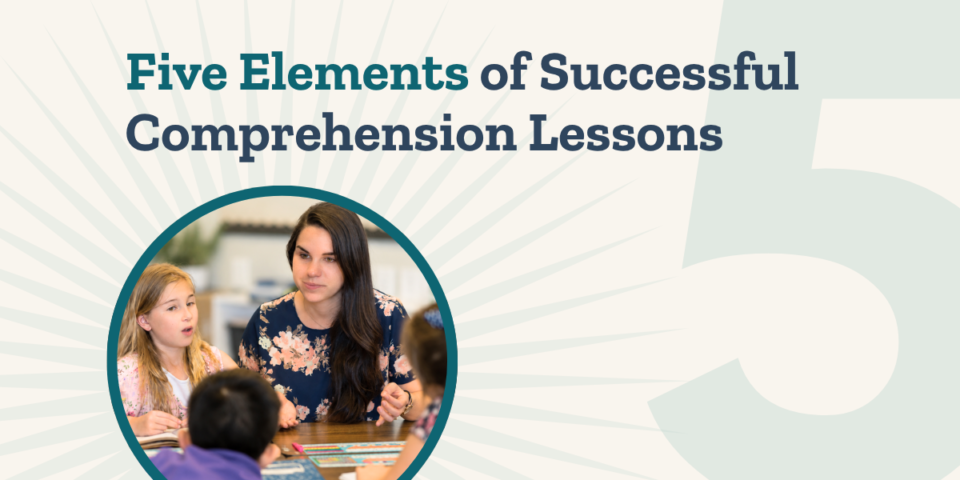
One question I hear again and again: “What makes an effective reading comprehension lesson?” Today I want to share the five elements I consider when planning a lesson, and why each matters for developing a lesson that truly engages students and helps them learn.
This process has become so familiar that planning typically takes just 10-15 minutes, and the plan fits on a page or two. I move through the five elements in order; together they create a plan that strengthens literacy skills and strategies, vocabulary, and knowledge-building: three areas every reading lesson should include. I keep these five areas in mind whether I’m planning to read aloud the text to students, read it with them during shared or close reading, or support them with a pre-reading lesson before sending them off to read independently or with a partner. Still, a plan is just a guide; some of what students need I can anticipate, and some will surprise me, so I’m always ready to pivot in the moment.
1. Consider Students’ Background Knowledge
I start by asking what my students already know and what they will need to know to comprehend this particular text. What can I leave for them to learn from the text during reading, and where will I need to step in?
Prior knowledge helps the brain connect, organize, and store new information. When students bring relevant background knowledge to a text, comprehension requires less mental effort, leaving more capacity for genuine thinking and learning.
2. Plan Vocabulary Instruction
Next, I decide which words are worth teaching and when to teach them This usually means a choosing a mix of Tier 2 words (words that appear across many contexts) and Tier 3 words (domain-specific terms), and deciding when to teach them: before, during, or after reading.
Teaching a word well means more than offering a definition. I look for opportunities to connect the word in the text to other words students already know, through morphology (word parts) or meaning.
3. Plan Writing About Reading
Written responses give students an opportunity to think on the page, capture their ideas, and bring something concrete to partner talk, book clubs, or whole-class discussion. So I make sure to plan opportunities for quick writes in response to prompts in most lessons.
Written responses also give me opportunities for ongoing assessment. When I review their writing and notice that several students are struggling with the same skill or concept, I know what to teach next, whether later in the same lesson or in a future one.
4. Plan Strategies and Prompts
A reading strategy is a step-by-step process: what to notice, what to ask yourself, and what to do. Naming the steps explicitly, modeling them, and then guiding students through the process using prompts makes the largely invisible work of reading visible and learnable.
I decide when to teach a strategy: before, during, or after reading.
5. Plan for Conversation
Finally, I build in opportunities for students to discuss the text: in pairs, small groups, or as a whole class. Research consistently links the quantity and quality of classroom conversation to stronger comprehension, greater reading self-efficacy, and growth in language and vocabulary.
Conversation also serves other crucial purposes: it is an opportunity to teach speaking and listening skills, and it makes students’ thinking visible providing a window into their comprehension. I decide whether to build in dedicated conversation time and how to group students, or whether the lesson itself is structured as a conversation, as in a book club.
Reflect After Teaching
Every lesson is also an opportunity to learn from students so I can plan next steps. What challenges are students having with comprehension, and where do they need additional support? Their written responses and conversations provide feedback — for them, and for me — about what is working and what needs to be adjusted going forward. Reflecting after a lesson keeps me responsive to students’ needs.
These five elements — background knowledge, vocabulary, writing about reading, strategies and prompts, and conversation — are what I consider every time I plan a comprehension lesson. This process keeps a fifteen-minute planning session both efficient and instructionally sound.

Jennifer Serravallo is the author of more than two dozen bestselling literacy resources for teachers. Her newest, Whole Book Comprehension for Grades 1-6, is due out this fall and provides lesson-by-lesson prompts, rubrics, strategies, and conversation scaffolds for a collection of included whole books: 4 fiction and 4 nonfiction titles per grade level kit.