By Jennifer Serravallo
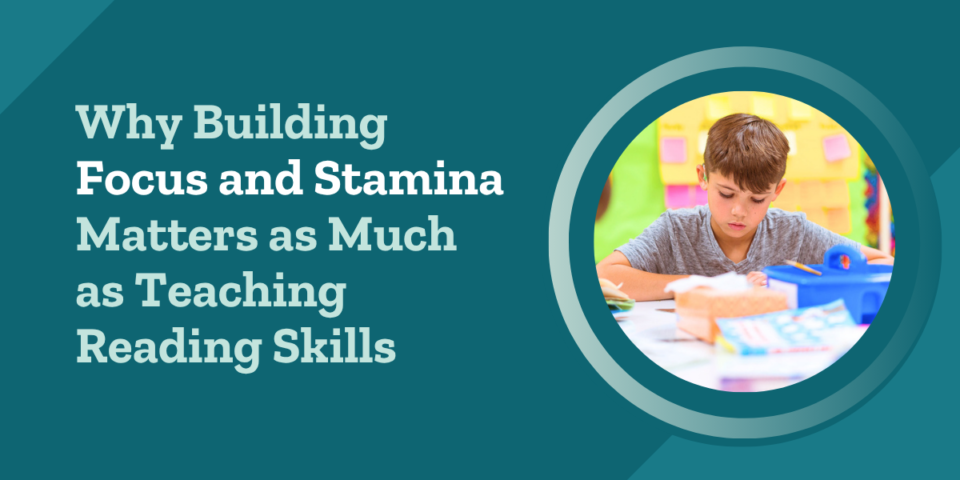
Ten minutes into reading, you scan the classroom and see fidgeting, wandering eyes, a hand sneaking toward a phone in a backpack pocket. You've heard the refrain from teachers everywhere: “They just can't focus.” “They don't have the stamina.” It's not your imagination, and it's not a failure of your teaching.
Why This Is Happening
Our students' attention has changed, and there's research behind why. A 2023 survey found that 83% of educators in grades 3–8 said their students' reading stamina had decreased since 2019; more than half said “a lot” (Sawchuk, 2024).
Screens are a big part of the story. Researchers point to phones, social media, and short-form video as habits that train kids to skim rather than sustain attention, a diet of brief snippets that doesn't build the muscle longer texts require. Neuroscientist Maryanne Wolf calls this “shallowing” (Serravallo, 2023): kids as young as eight or nine growing so conditioned to scrolling and word-spotting that they stop accessing the reading brain's deeper layers, a pattern one large study linked to changes in executive function and focus (Law EC, Han MX, Lai Z, et al., 2023).
What the Active View of Reading Says
For decades, reading models focused on two categories: word recognition and language comprehension. A newer framework, the Active View of Reading (Duke & Cartwright, 2021), adds a third: active self-regulation which includes motivation and engagement, executive function skills like working memory and inhibitory control, and strategy use. As researcher Kelly Cartwright puts it, these skills “undergird and drive word reading, language comprehension, and...help readers coordinate these processes in service of comprehension.” (Serravallo, 2023).
We can and should support skills such as attentional focus: blocking out distractions, whether from the environment or from one's own mind, to center on the text; self-monitoring: recognizing when your mind has drifted, and using strategies to reengage, a skill shaped by what children know about making and holding onto plans and goals; and stamina: sustaining reading over extended stretches of time, and persevering through the harder parts.
What Do We Do About It?
Stamina and focus aren’t traits some kids have and others don't. They are skills that develop through deliberate practice, which means we can teach them, the same way we teach any other skill.
A few places to start:
- Ensure students have a reading plan. A clear lesson focus, or a goal they set themselves, Cartwright notes, is part of comprehension planning, managed by the same executive skills that support focus. Readers who know why they're reading persist with it (Serravallo, 2023).
- Teach students to notice and re-focus. Students benefit from explicit instruction in setting goals, checking their own attention, and using self-talk to refocus (Mason et al., 2013). Like any muscle, it strengthens with guided practice.
- Let them read, read, read — especially with whole books. Longer texts demand more: holding more in working memory, tracking characters and ideas over time, updating a mental model as the story unfolds. Mesmer and Hiebert (2015) found text length multiplies the effect of complexity in third graders; a longer, complex text is a different cognitive task, not just a bigger short one.
- Let them talk about books, together. Reading doesn't have to be solitary, and often shouldn't be. Partners and small groups keep kids engaged, and engagement and focus feed each other. Talking or writing about a text keeps kids invested. An engaged reader is a more focused one, more willing to push through to the end.
The recipe for success with focus and stamina is similar to any other skill you’re trying to teach: use explicit instruction, offer strategies, and provide practice. Our students' attention hasn't disappeared; it’s a muscle that needs time to practice with engaging texts and scaffolding that supports them.
References
Duke, N. K., & Cartwright, K. B. (2021). The science of reading progresses: Communicating advances beyond the simple view of reading. Reading Research Quarterly, 56(S1), S25–S44.
Law EC, Han MX, Lai Z, et al. Associations between infant screen use, electroencephalography markers, and cognitive outcomes. JAMA Pediatrics. 2023;177(3):311–318.
Mason, L. H., Meadan-Kaplansky, H., Hedin, L., & Taft, R. (2013). Self-regulating informational text reading comprehension: Perceptions of low-achieving students. Exceptionality: A Special Education Journal, 21(2), 69–86.
Mesmer, H. A., & Hiebert, E. H. (2015). Third graders’ reading proficiency reading texts varying in complexity and length: Responses of students in an urban, high-needs school. Journal of Literacy Research, 47(4), 473–504.
Sawchuk, S. (2024, January 15). Reading comprehension challenges and opportunities, in charts. Education Week.
Serravallo, J. (Host). (2023). Dr. Kelly Cartwright: The active view of reading framework and the role of executive skills in reading comprehension (No. 1) [Audio podcast episode]. To the classroom: Conversations with researchers & educators.

Jennifer Serravallo is the author of more than two dozen bestselling literacy resources for teachers. Her newest series, Whole Book Comprehension for Grades 1–6, is due out this fall. Each grade-level kit includes eight whole books, four fiction and four nonfiction titles, along with lesson-by-lesson writing prompts and instruction, rubrics, strategies, and conversation scaffolds for teaching them.