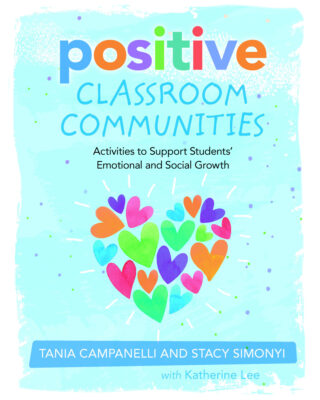
by Tania Campanelli & Stacy Simonyi. They are the authors of Positive Classroom Communities.
MTSS Overview
You have likely heard about Multi-Tiered Systems of Support, or MTSS, which is “a proactive and preventative framework that integrates data and instruction to maximize student success from a strengths-based perspective” (American Institutes for Research, 2026, para 1). Used by schools, this practice provides different levels (tiers) of support based on students’ needs.
- Tier 1 - Universal Support provides high-quality, whole-class instruction of a topic
- Tier 2 - Targeted Support provides extra, small-group instruction for students who are struggling
- Tier 3 - Intensive Support provides individualized, one-to-one interventions
In essence, MTSS is a way schools can provide support for students in a preventative way. For more information, check out The AIR: Center on MTSS at https://mtss4success.org.
When it comes to SEL, don’t skip Tier 1!
When it comes to academics—specifically math and literacy skills—teachers often use MTSS to create meaningful, data-driven instruction for students. Students receive whole-class instruction, and then, during intervention, they are placed in small groups to practice the skills they need to strengthen. For example, a third-grade class learns the array method for multiplication during their tier 1, whole-group instruction. However, after reviewing their individual work, the teacher notices some students are struggling. These students are placed in a small group to work on repeated addition with the school’s math interventionist. There’s a clear understanding that, in order to succeed, students need both Tier 1 and Tier 2 instruction; Tier 2 doesn’t replace Tier 1.
But when it comes to SEL, we don’t always think through this lens.
Does this sound familiar: a school counselor sends an email asking teachers to identify students who need practice with social and emotional skills. The teachers identify students in their class who might need targeted support for social and emotional skills, and the school counselor forms groups to help students build their social skills. What’s missing here? While the concept in itself is great (these groups do have an impact on students’ learning (Miller, 2017)), there is no conversation about what Tier 1 SEL instruction has been provided; this scenario skips straight to Tier 2 intervention.
If we don’t have a strong Tier 1 level of social and emotional learning, then more and more students will eventually need Tier 2 and Tier 3 support.
MTSS for SEL
If we use the MTSS framework for social and emotional skill development, we would see a similar tiered system used for proactive and preventative purposes, as well as in response to the skills students are demonstrating throughout the school day. Just as in an academic MTSS framework, all adults provide different forms of support to students throughout the school day.
- In Tier 1 instruction, the classroom teacher creates lessons and activities to teach students a particular social and/or emotional skill. Note that these skills must be taught; while we have differing capacities to learn social and emotional skills based on our development, we don’t automatically have these skills—in other words, we can’t depend on nature, we need nurture to learn them. In addition to explicit instruction, classroom teachers can use general practices that intentionally provide opportunities to practice social and emotional skills throughout the school day. In Positive Classroom Communities, we provide activities and general practices that can be used for Tier 1 instruction and can be modified for Tier 2 support.
- In Tier 2 instruction, students who are having difficulty using a social or emotional skill are provided with additional interventions, such as small-group discussions or activities, to give them extra practice with the skill or additional explicit instruction. Classroom teachers may provide this support in the classroom; school counselors or special educators may also use this small group instruction when necessary. Small social-skills groups with the school counselor are a good example of Tier 2 support.
- Tier 3 instruction provides individualized support to a student who needs help practicing a social or emotional skill in the moment. Individual student check-ins or therapy might be appropriate for students having difficulty with a social and/or emotional skill after receiving the Tier 1 and Tier 2 instruction. Tier 3 interventions might include in-school therapy sessions, in-school sessions with a social worker, or one-on-one time with a special educator.
Taking a thoughtful approach to SEL within an MTSS framework starts with strong Tier 1 instruction, ensuring all students have consistent opportunities to learn, practice, and apply essential skills. Rooted in the trusted CASEL framework, we wrote Positive Classroom Communities to give you practical general practices and fun, play-based activities to help you build that foundation and support every student’s social and emotional growth.
References
American Institutes for Research. (2026). Essential Components of MTSS. https://mtss4success.org/essential-components
Miller, G. (2017). Could your child benefit from a social skills group? https://www.rileychildrens.org/connections/could-your-child-benefit-from-a-social-skills-group