by Jennifer Serravallo
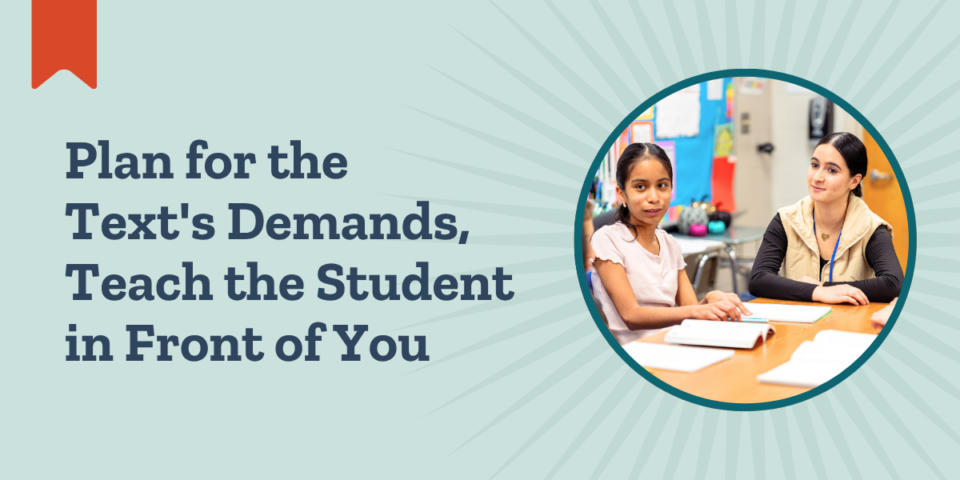
How do you balance the demands of the text with the needs of your students? Planning starts with the text itself: what it asks of readers shapes your objectives, the strategies you teach, the lesson type you choose, and even how you deliver instruction. But you also need to think about the students who’ll be reading it: where their previous work aligns on a skill progression, whether they’ll need heavy support or just a light touch, and what kind of modeling will best meet their needs. Of course, even with the most thoughtful plans you’ll need to be ready to pivot in the moment, since students will always surprise you.
Considering the Text’s Demands
Every text makes its own demands on a reader. A dense science article asks students to juggle technical terms while also using key textual features to synthesize meaning. A historical narrative asks them to track shifting perspectives while visualizing distant times and places. A poem asks them to interpret figurative language and determine a central meaning.
Planning starts with a step that’s easy to skip: read the text the way a student would, and think about where they might get stuck. Consider: How relevant is this text to my students’ interests and identities? Does it connect to what we’re studying? What background knowledge does the author assume, and do my students have it? What’s genuinely hard here, and what strategies will they need to work through it? The answers to these questions are what should drive your lesson planning.
Comprehension instruction works best when tied to a specific text, not offered as random, isolated strategies (Duke, Ward, and Pearson, 2021); students learn strategies by using them to make sense of meaningful texts, not by completing worksheets about them. That means strategy instruction becomes responsive; you teach inference because this text demands it, not because it’s next on the pacing calendar, and you teach the vocabulary that helps students understand and build knowledge from the text they’re reading.
Strong planning extends beyond a single lesson. Teachers need to think not only about today’s text, but about how texts connect across days and weeks. Students understand texts more deeply when they have background knowledge, topic familiarity, and repeated exposure to important vocabulary and concepts (Cervetti and Hiebert, 2015). That’s why building instruction around connected texts, tied together by shared ideas, helps reading start to feel more manageable: students are building something. This is also why whole books still matter; some thinking only happens when students stay with a text long enough for meaning to deepen through sustained engagement. Vocabulary sticks. Ideas become more complex. Learning grows.
Considering the Students’ Needs
Explicit instruction means teaching with intention and clarity, in a structured, systematic way, but that doesn’t mean it needs to be scripted with no flexibility to deviate. Students should stay highly engaged and active, and you need to be ready to adjust your plan on the fly to keep everyone moving toward the goal.
That means actually listening: to how students read, what they say when they answer questions or talk about the text, and what you notice as they work. Listen in on turn-and-talks. Look at their stop-and-jots. Then be ready to pivot: jump into a quick think-aloud, ask a different question, offer some redirection or praise, or simply pick up or slow down the pace.
It helps to keep a skill progression in the back of your mind while you listen. With fluency, for instance, notice whether a student is reading word-by-word, in short phrases, in longer phrases, or with real expression, and coach them toward the next step. What matters most is tuning in to the feedback students are constantly giving you: what they can already do, where they still need support, and what’s confusing them. That’s where responsive teaching actually happens.
Bringing It Together
Text demands should drive lesson planning. Student needs tell you how to fine-tune it. Skip the first, and you risk aiming at the wrong target. Skip the second, and you risk marching forward while nobody’s really learning. Put them together, and you’ve got both a clear destination and the flexibility to get every student there.
References
Duke, N. K., Ward, A. E., & Pearson, P. D. (2021). The science of reading comprehension instruction. The Reading Teacher, 74(6), 663–672.
Cervetti, G. N., & Hiebert, E. H. (2015). The sixth pillar of reading instruction: Knowledge development. The Reading Teacher, 68(7), 548–551.

Jennifer Serravallo is the author of more than two dozen bestselling literacy resources for teachers. Her newest series, Whole Book Comprehension for Grades 1–6, is due out this fall. Each grade-level kit includes eight whole books, four fiction and four nonfiction titles, along with lesson-by-lesson writing prompts and instruction, rubrics, strategies, and conversation scaffolds for teaching them.