by Jennifer Serravallo
Every teacher knows the rhythm: pause the read-aloud, turn and talk or stop and jot. It feels productive. Kids are talking and writing, the room has energy, and the lesson keeps moving. But providing opportunities for conversation or writing isn't the same as teaching these skills. Let’s bring in explicit instruction!
The Research Behind the Practice
Studies show that structured talk about text supports reading comprehension (Cazden, 2005; Wilkinson et al., 2015), builds cognitive skills (Sousa, 2017), and grows language and vocabulary (Zwiers & Crawford, 2009), gains that are especially powerful for multilingual learners. Short, frequent writing about reading has similarly been shown to improve retention and strengthen comprehension.
Strategies: The Scaffolding That Moves Thinking Forward
Strategies are what make the instruction work; they're the step-by-step scaffolding that helps students move from "I read it" to "I understand it, and I can show you how."
Teaching students how to talk about books. When we teach students how to have productive discussions, we show them how to present ideas respectfully, back them up with textual evidence, and anticipate a classmate's counterpoint. Or we might teach them to listen attentively, weigh a peer's perspective, and stay open to changing their mind. Concrete moves — such as asking a follow-up question, building on someone else's idea, and offering a relevant example — are what keep a discussion alive instead of stalling out after one comment.
Students also need strategies for figuring out what's worth talking about. Not every detail in a text carries the same weight, and kids often struggle to separate a detail that's important from one that's simply colorful or interesting. They need to be taught how to follow an argument, identify character traits, determine the principal theme, and pull textual details to support their ideas as they discuss them with their classmates.
Teaching students how to write about books. Writing about reading takes different forms, and students need to be taught what each one looks like, when to use it, and what makes it effective.
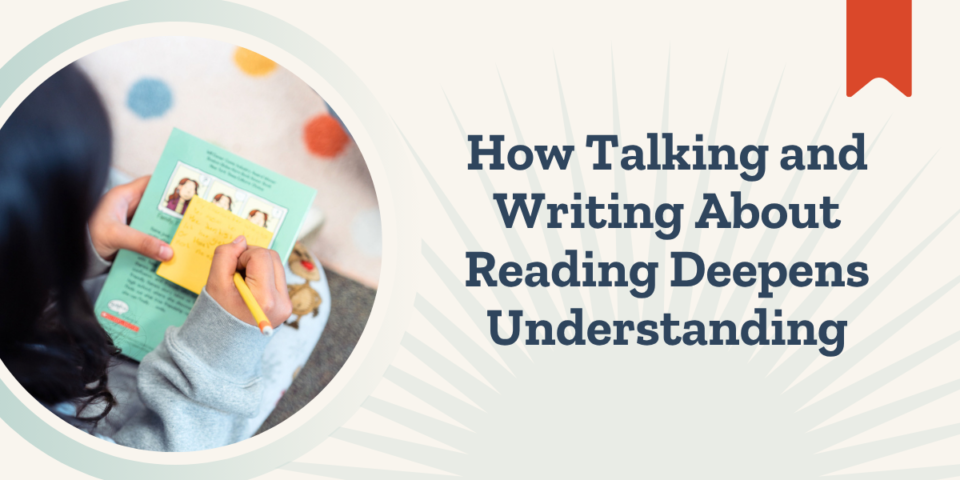
Annotation is the quickest form. A symbol system, such as an exclamation point for surprise, a question mark for confusion, and a star for importance, lets kids mark a reaction and keep moving without stopping their reading for long, with the option to revisit it later. Marginal notes or sketches and sticky notes serve a similar purpose, offering quick, low-stakes captures of thinking in the moment that give students something concrete to return to.
Prompts help students extend their thinking. Once they can capture ideas quickly, they're ready to write with elaboration: sorting their notes by topic, adding on to one part with a bigger idea and evidence from the text, copying down a powerful line and reacting to it, or explaining how a conversation with a partner changed their thinking. Students also need explicit guidance on what a prompt actually calls for, including what merits inclusion, what to leave out, how long a response should run, and what tone fits the task. Without that instruction, responding to a prompt is as vague an assignment as being told to discuss with a partner, and it produces the same uneven results.
Closing the Gap
More time to talk or more paper to write on is only more powerful when we teach them how: how to build a discussion, how to choose what matters, how to jot a note that's worth revisiting, how to shape a written response with purpose. That explicit instruction is what turns talking and writing from classroom routine into real engines of comprehension, and it's worth the time it takes to teach.
References
Cazden, C. B. (2005). The value of conversations for language development and reading comprehension. Literacy Teaching and Learning, 9(1), 1–6.
Sousa, D. A. (2017). How the brain learns (5th ed.). Corwin.
Wilkinson, I. A. G., Murphy, P. K., & Binici, S. (2015). Dialogue-intensive pedagogies for promoting reading comprehension: What we know, what we need to know. In L. B. Resnick, C. A. Asterhan, & S. N. Clarke (Eds.), Socializing intelligence through academic talk and dialogue (pp. 37–50). American Educational Research Association.
Zwiers, J., & Crawford, M. (2009). How to start academic conversations. Educational Leadership, 66(7), 70–73.

Jennifer Serravallo is the author of more than two dozen bestselling literacy resources for teachers, including The Reading Strategies Book 2.0 which many of the ideas in this blog are drawn from. Her newest series, Whole Book Comprehension for Grades 1–6, is due out this fall. Each grade-level kit includes eight whole books, four fiction and four nonfiction titles, along with lesson-by-lesson writing prompts and instruction, rubrics, strategies, and conversation scaffolds for teaching them.