Adapted from Technology with Intention by Suzanne Kelly and Elizabeth Dobler.
Background, or prior knowledge, shapes the ways students make sense of new information—a critical part of inquiry. Jean Piaget’s neuroscience research (1972) helps us understand how the brain forms connections between bits of information as new knowledge is constructed and stored in the brain’s logical information storage system or schema. Multimedia, including videos, podcasts, graphics, text, and animations, can provide a boost or quicken the pace of acquiring background knowledge. Visual literacy skills are a key foundation for students to make meaning from images, critically analyze the messages within photos, videos, and other media, and to use this information to solve a problem or create a project.
The cognitive theory of multimedia learning (Mayer and Moreno 1998) stems from the idea that two key channels of brain learning are visual (images, written text, animation, videos) and verbal (spoken narration). Meaningful learning, the building of background knowledge, occurs when both paths are utilized at the same time. A video with captions or print with an audiobook lets a reader use two pathways for learning. However, the research of Mayer and Moreno shows that more is not necessarily better, and there can be a point where too many options impede learning. Spoken text with images is an effective way of sharing information, but if animation is added, then the cognitive load may be too much for the learner. The additional pathway may serve as a distraction rather than a support.
When using multimedia resources with students, strive to locate and create quality resources that maximize learning, but be aware of how multimedia presents information to avoid overload or distraction. A team of researchers set out to understand the ways multimedia resources can best meet the learning needs of students. The team concluded that a student’s amount of background knowledge impacted the time it took to understand multimedia (X. Yang et al. 2018). Learners with high background knowledge spent more time reading and viewing the new information and more time transitioning between graphics and text. On the other hand, students with low background knowledge needed more instruction to develop a coherence between their knowledge and the new information in the multimedia resources. This finding led to the conclusion that when multimedia resources build in prompts to help viewers access and build background knowledge, learning is more successful. Additionally, many students can benefit from a teacher’s explicit prompts to link new information to their background knowledge. As always, effective use of the technology relies on quality instruction from the teacher.
Consider how you use technology to build background knowledge. How-to videos guide viewers through the steps of a project, getting the brain ready for the actual hands-on experience useful for constructing knowledge (Goodyear and Retalis 2010). It’s likely if you want to begin a new hobby, the internet is one of your first stops. When I wanted to learn how to crochet a scarf, I went online to read about crocheting, see diagrams of different sizes of hooks, and view tutorial videos. With some practice, I was soon on the way to my first crochet project. Technology supported me as I learned a new skill, but I really took off when I sat down with my aunt, a master crocheter, who gave me specific feedback about my work. The combination of tech’s knowledge-building opportunities and a teacher’s instruction is key.
We want students’ background knowledge to grow in ways that lead to developing an understanding of new information—to learn. Yet multimedia resources, possibly more so than print resources, are influenced by popular culture, mass media, and social media. Media literacy skills are critical for students’ understanding of what they see and hear in multimedia resources. The National Association for Media Literacy Education defines media literacy as “the ability to access, analyze, evaluate, and communicate information in a variety of forms including print and nonprint messages” (n.d.) Thinking critically about the messages they receive and create is imperative for our students, as they prepare for their future role as voting citizens. Research suggests explicitly teaching media literacy skills can lead to improvements in critical thinking about bias and misinformation in messages, and an understanding that people interpret media in different ways (Jeong, Cho, and Hwang 2012; Kahne and Bowyer 2017; Webb and Martin 2012).
Teachers can support students’ development of media literacy skills by embedding instruction amidst inquiry-based lessons. Teach students to
- identify the creator, the purpose, and the point of view of a resource. Build students’ capacities for understanding how messages are constructed and the assumptions on which messages are built (Hobbs and Moore 2013).
- sort fact from fiction by defining and using terms accurately (e.g., fake news, misleading news, false news, propaganda, hoax, sponsored content). Utilize the infographic “Beyond ‘Fake News’ 10—Types of Misleading News” as a reliable source for developing these concepts (Hobbs 2017; Steinberg 2017).
Although media literacy concepts may seem complex, developing critical analysis skills can begin at an early age. I work with a kindergarten teacher who uses a shared reading time to focus on teaching fact and opinion. Students are introduced to a website that sells products and one that only provides information. Together, she and the students discern which website is fact and which is opinion. As children become older, the focus can shift to identifying hidden messages and considering the value of multimedia within the social, political, and cultural climate of the time.
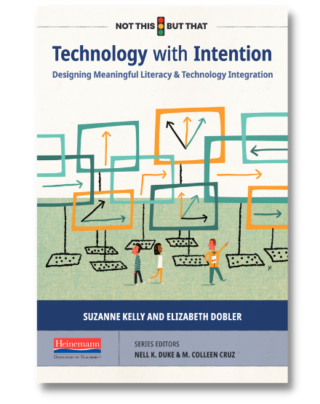
While there are books that show you how to include tech, Technology with Intention also addresses how to decide whether to use tech at all. Intentional is the key word for integrating technology into instruction, and you will find helpful guidelines and prompts to help you decide when, how, and why to use technology with your students.