
Adapted from How to Become a Better Writing Teacher by Carl Anderson & Matt Glover
There is one overarching reason to develop your skill as a curriculum decision-maker: The only person who can truly know what your students need to learn tomorrow is you. After all, it’s you who was with your students today, talking with them about their writing in conferences and reading their writing. And it is you who can take what you learn about your students each day and make decisions about what just-right step should come next (Hertz and Mraz 2018; Meehan and Sorum 2021; Roberts and Roberts 2016; Tomlinson 2014).
When you’re a curriculum decision-maker, there are some other benefits:
- You’ll deepen your knowledge base about writing.
- You’ll be a teacher who reads and uses curriculum products with a critical lens rather than as a passive consumer.
- You’ll have an insider’s understanding of your units and how the lessons work together to achieve your goals for students.
- You won’t be powerless when commercial curriculum products are compromised by unjust state and national pressures and laws.
Assuming the identity of curriculum designer may be a major shift in the way you see yourself and your role as a teacher.
Following are just three (of the seven detailed in the book) steps you can take to helping shape your curriculum.
1. Revise Existing Units
Before you revise a unit, it’s important to start by becoming thoroughly familiar with it. Read it from beginning to end! Designers of a unit, whether they’re the authors of a commercially available unit, or a school or district team who created the unit, put a lot of thought into creating it, and it’s important you understand its flow and logic.
Knowing the unit’s lessons will also help you assess students as it unfolds. As your students write, you’ll be asking yourself, What do my students already know about the topics of upcoming lessons?, which will help you decide if you need to revise them.
Knowing the unit well will also help you make your case if you are asked by colleagues or supervisors to justify revisions. Speaking knowledgeably about an existing unit will help you show that you carefully considered the changes you’re making.
Make Revisions to Individual Lessons. When you decide to revise an existing minilesson, how can you make it more or less challenging for your students?
- For craft minilessons, look at the unit’s mentor texts for examples that will provide an appropriate challenge for students.
- For process lessons, teach a strategy you used while writing your process text instead of the one taught in the unit.
- You could use a professional book such as Jen Serravallo’s The Writing Strategies Book (2017) to find an alternative minilesson.
Add (and Subtract) Lessons. Since you don’t want units to run over time, if you add minilessons to a unit, you should subtract others from the unit plan. To make thoughtful decisions about which minilessons to remove, ask yourself these questions:
- Given what I’ve learned about students as the unit has unfolded, which upcoming minilessons are the lowest priority?
- Which upcoming minilessons focus on topics most of my students have demonstrated they can already do?
- Are there any upcoming minilessons that seem too challenging for most students?
Move a Lesson to a Different Place. Finally, upcoming lessons may seem out of place. As you confer and read student writing, you may decide to move up a minilesson to address a need that is coming up frequently. Or maybe you’ll decide a minilesson is better placed later on in the unit, since the lessons that currently follow it better address the needs you’re seeing now.
2. Project Units of Study
To project, or design, units of study (Glover and Berry 2012; Ray 2006), follow these steps:
- Give the unit a name, defining its focus.
- Gather a stack of mentor texts, and mine them for craft teaching points.
- Write a process text, and mine it for process teaching points.
- Set a primary goal for what you’ll be teaching in the unit and then choose secondary ones.
- Draw upon your knowledge about how units of study are structured and the writing process to arrange the minilessons in a logical order.
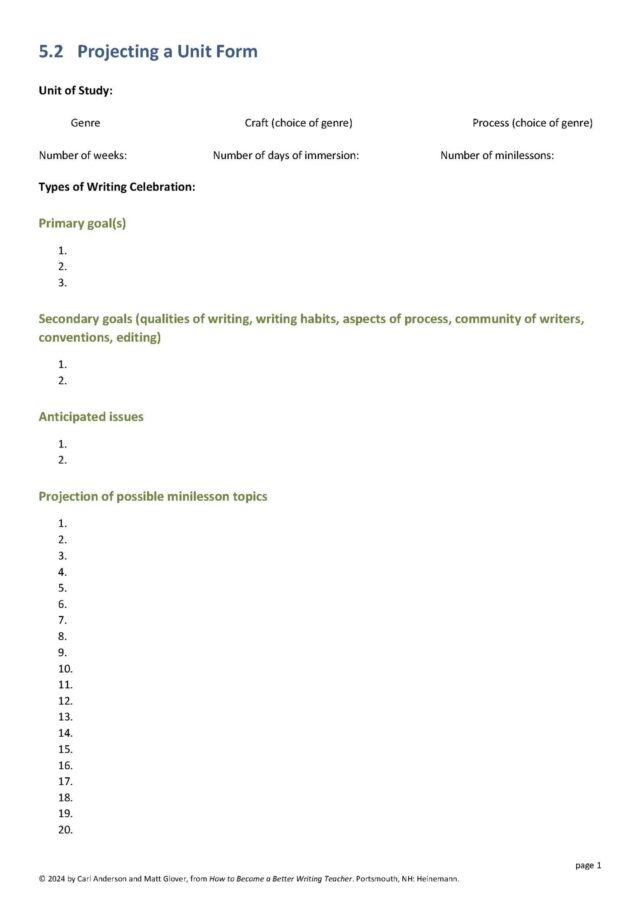
Download the form below and see Chapter 5 for details on filling it in.
3. Talk to Your Principal
What if you don’t have a ton of agency, and you’re expected to follow lessons in existing units as written? What can you do to create a professional space in which you can be a curriculum decision-maker? The starting point is to talk with your principal and other members of your school’s leadership team.
As a starting point, initiate a conversation about the school’s beliefs. Use some of these conversation starters as entry points to the conversation. Ask questions like these from a place of honest curiosity. Doing so can lead to meaningful conversations.
- Does the school or district believe students learn and grow at different rates? That students start and end the school year in different places?
- Does the school or district believe that since classes are made up of students with different needs, it follows that different classes will have different collective needs?
- Does the school expect teachers to assess their students and make instructional decisions based on what they learn?
- Does the school believe students learn by trying things out, evaluating how it goes, and making changes for next time? If so, does the school believe teachers learn similarly?
- Does the school or district think all schools are exactly the same, with the same needs? If not, does that also apply to classrooms in a school?
The more challenging part of this conversation comes when you shift toward asking questions about actions. Assuming your principal’s responses to questions about beliefs were in the affirmative, you know there is misalignment about beliefs and the actions you’re empowered to take in your classroom. Asking about actions begins a conversation about this misalignment and opens up a space to talk about how to address this misalignment.
- Since the school believes different classes need different things, why should all teachers teach the same sequence of minilessons in a unit?
- Since the school believes teachers should make decisions informed by what they learn about students, does that apply only to writing conferences and small-group lessons? Shouldn’t it also apply to minilessons?
- Since we agree that different schools need different things, why doesn’t that apply to different classrooms?
- Since the school believes it’s important teachers know their students as writers, why shouldn’t they make important instructional decisions about units of study?
To help your principal feel comfortable with you revising or projecting units, it helps to give specific examples. For example, pick a lesson from a unit you want to change, or a lesson in a previous unit that you did change or wanted to change. Then you could do one or more of the following:
- Explain the rationale for the change you want to make or did make.
- Point to data that supports the change you want to make. For example, you might say, “From looking at their writing so far in the unit, I found over half of my students can already do what the next minilesson teaches, so I don’t think I should teach it.”
- Show your principal writing samples that are evidence for the type of change you want to make.
- Invite your principal into your classroom so they can watch the lesson you changed or swapped in, so you can have a conversation about how it went.
- Explain you don’t expect the principal to trust you blindly because “teachers always know best.” Explain you want to share the thinking behind your decisions and would like their support to help you better meet your students’ needs.
- Suggest a series of periodic conversations to talk about how your unit decisions are going.
Chapter 5 of How to Become a Better Writing Teacher is entirely about shaping your curriculum and being a decision-maker. Get the book for more!