Adapted from Scott Sundstrom's Creating Safe and Welcoming Classrooms for LGBTQ+ Students.
The LGBTQ+ community is diverse, encompassing people from layered and intersectional identities. Some of these social identities are privileged in society, while others are marginalized. When we are truly invested in making our classrooms safe and welcoming to all, we must be aware of our own identities, the identities of others, and the power or marginalization that often accompanies identities. For example, as a white, gay, cisgender male, I recognize that many aspects of my identity hold power. Considering our own identities and the identities of others enables us to recognize our own biases and gaps in understanding as we actively seek to learn from those who have come before us.
Following are five pedagogical pathways for creating safer and more inclusive classrooms:
Challenging Gender-Based Stereotypes
Before children enter school, they have developed gender stereotypes (Martin and Ruble 2004; Signorella et al. 1993), and without interruption, these ideas about gender become deeply ingrained (Aina and Cameron 2011). In your classroom, I’d bet you have seen children exhibit pronounced responses when one of their peers violates an established gender-based rule.
“Hey, you can’t play with that. Those blocks are for boys only!”
or
“Boys aren’t allowed to read those Junie B. Jones books!”
or
“The football field is only for boys to play on!”
This happens all the time.
Unfortunately, schools often strengthen the gender binary, rather than challenge it. This is why interrupting the gender binary and challenging traditional notions about gender is so important. To get better at this in our teaching, we can start by reflecting on our own social identities.
Supporting Your Students’ Advocacy for inclusive language
Once we start using more inclusive language in our classrooms, students often begin to take the lead. After fifth-grade teacher Nikoline Tushar did a handful of lessons on using pronouns, one of her students wrote an article for the school newspaper about what they had learned.
Later in the year, Nikoline’s students pushed back when a substitute teacher refused to acknowledge one of their classmates by using they/them pronouns. Nikoline had created a safe and inclusive environment that her students were passionate about upholding. The students asked Nikoline if they could write a letter to their school principal explaining the great harm this substitute teacher caused to their peer and requesting that the substitute teacher not be welcomed back to their school.
While these ideas and initiatives originated with the students, Nikoline’s support is also a factor in this situation: It’s easy to imagine a situation in which a teacher’s fear might result in deciding not to submit the newspaper article, or perhaps suggesting that the students forget about the substitute teacher’s actions. We need to be ready to support our students when they take brave steps.
Engaging Learners Through Stories
When considering children’s literature for use in your classroom, ask yourself, “How will my students experience this text? Who will feel included and inspired, and who will feel excluded and defeated?”
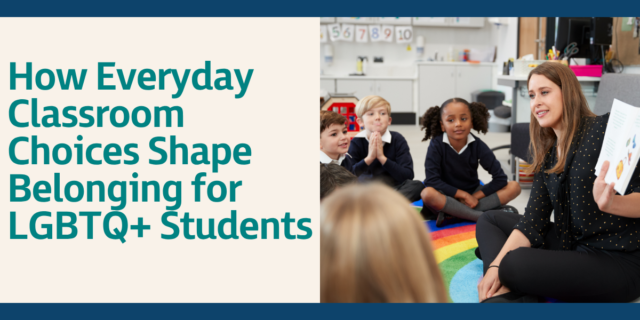
Amy Cooper, in her kindergarten classroom, read aloud the Caldecott Honor Book® Alma and How She Got Her Name by Juana Martinez-Neal, a story about a girl who first questions her name and then comes to love it as she learns its connection to her family and history. Amy used the text as a starting place for discussing the origin of everyone’s name in the class, but then shifted the conversation to introducing nonbinary people. She asked her students, “Why might someone not like the name they were given as a baby and want to change it?” After she let her students share, Amy did some explicit teaching about nonbinary individuals. In the story, there are no LGBTQ+ characters, and no characters who overtly defy gender norms, but through engaging in children’s literature, Amy gave her students a glimpse into the lives of nonbinary and transgender people. And, because of this, Amy’s students began to use they/them pronouns at school. Amy also extended this learning into subsequent lessons later in the year.
Drawing Upon Community
You cannot make your classroom a safe and inclusive space without drawing upon community. By community, I mean a group of people who share common attitudes, interests, and goals—your school community, your local community, and your online community. In her 2014 book Thrive: 5 Ways to (Re)Invigorate Your Teaching, Meenoo Rami talks about the importance of joining and building networks both near and far to provide the guidance, support, and collegiality that keep us going even when our work is challenging—and this work is challenging. It becomes more manageable when you are intentional about connecting with others. When you know that you are not alone, and that there are others who are trying to do the same thing as you are, this work doesn’t seem so overwhelming.
You must find your people.
One way to do this is to connect with web-based communities. These spaces can be less intimidating because you have the option of observing before contributing. For example, you can follow educators on social media such as Instagram® who are passionate about inclusive education. You’ll then see messages in your feed that could inform your teaching. Use hashtags to search for such educators.
If you are fortunate enough to have colleagues or other teacher friends who you can be vulnerable with, you might talk with them about this work, sharing both the things that are going well and the things that you’d like to improve in your teaching. This trusted person need not be an expert, just someone who is willing to listen, to offer support, and—when possible—to offer feedback or guidance. Many teachers I’ve worked with have found that collaborating with others has improved their practice. You might even consider bringing this work to your entire grade-level team. If you are working with a group, it can be beneficial to set aside intentional planning time to work together. Anchoring your work with a book can be a way to get you started together.
Normalizing Representation
To normalize all our students’ identities and experiences in the classroom, we must be knowledgeable about people from cultural and social backgrounds differing from our own. We need to identify the areas in which we need to learn and then seek to learn more and do better.
Think about the factors that make people differ from one another—race, ethnicity, gender, sexual orientation, socioeconomic status, ability, age, religious belief, political conviction, just to name a few. Humans have diverse identities; your students have diverse identities. And your responsibility, as the teacher, is to create a safe space for all these young diverse humans to learn, grow, and thrive. For that to happen, you must ensure that your students’ identities are represented in the classroom, and that you normalize perspectives that are underrepresented or absent.