Adapted from All Minds on Mathematics by Wendy Ward Hoffer.
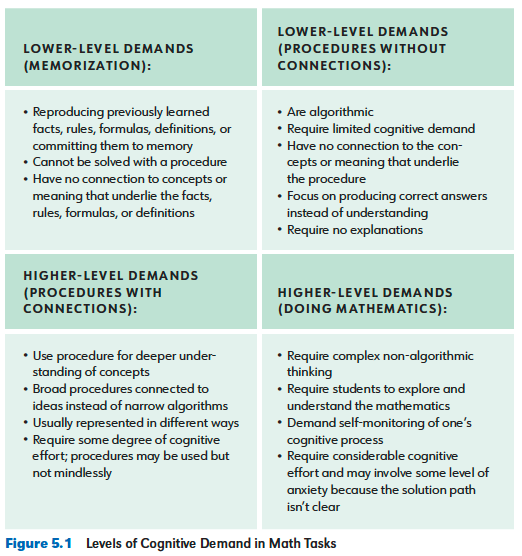
The best tasks are worthy of learners’ investment of time and effort because their content is relevant and interesting, because they address grade-level standards and invite the use of transferable math practices. As curricula come into step with current research, more and more resources for worthy tasks may be available to you. At times, you may need to shop online for a rich task or take a problem set you have on hand and enrich it yourself. A rich, worthy, engaging task is challenging, standards-driven, lifeworthy, and aspirational.
Challenge
When we hold the bar high and challenge learners to find their way through a problem, we are saying to them, “I believe in you, an astute thinker with the capacity to persevere and solve this thing that may, at first glance, appear impossible.” This does not mean that we throw them to the sharks and walk away, but rather that we don’t shy from the rigorous work of making meaning.
Standards-Driven
Clarity of purpose is critical to our success. As John Hattie (2009) illuminated in his research on Visible Learning, clarity has an effect size equivalent to learners making two years of progress in just one year. When students understand the goals, have a realistic understanding of their own progress toward those ends, and grasp how to expedite their achievement, they are endowed with valuable perspectives that inspire them to persevere. To this end, beginning with our standards, we develop learning targets and align our tasks to those targets, which we then communicate to students through interactive conversation.
When identifying our instructional purpose, we can attend to both content and process: which math topics we are striving to understand (content), as well as which skills, strategies, practices, or habits of mind we are practicing (process). Clarity and communication about the latter offers opportunities for learners to intentionally rehearse and refine transferable problem-solving approaches that will grow their strengths as capable mathematicians.
Lifeworthy
Lifeworthy is a term coined by David Perkins (2014) to describe work that has import and relevance beyond the walls of school and truly matters to students. In the context of math learning, it is the answer to the age-old question, “When am I ever going to use this?” The quest for life-worthiness urges us, as math learners, to look beyond the naked numbers and the math-for-math’s-sake mentality to find an application of the content we are studying. As has been aptly criticized by many a social media post, “contextualized math” dies on its own sword when we invent ridiculous ventures like an individual purchasing 83 watermelons at a grocery store. Life-worthiness asks us, as math educators, to go beyond making up a possible application for the content to deducing when in their real lives—or the lives of their families—learners would be able to use this concept or skill.
Here are some questions you might ask yourself when striving to unearth the life-worthiness of a certain math concept:
- How do I use or have I used this in my own experience?
- Who uses this in a professional setting?
- How might this topic connect to our community?
- Which of students’ interests connect to this topic?
- Why should a child care about this mathematical idea?
Aspirational
In her important book Unearthing Joy, author and professor Gholdy Muhammad (2023) identifies five critical pursuits for all learners: identity, skills, intellect, criticality, and joy. The math content we study can inform students’ identities in a number of ways: first, by connecting them with positive disposition and by inviting them, as strivers, to do math related to who they and our communities can become. Aspirational math asks learners to apply mathematical ideas for the community good. Instead of planning a bike trip for their own pleasure, perhaps they can plan a fundraiser for a worthy cause. Rather than calculating how to share brownies with their classmates, students might be asked to offer those treats to their school’s custodial staff. While it may not be practical to get out and actually do those activities, the math contexts we offer can welcome learners to see themselves as changemakers applying their math skills to assist with the uplift of the community at large. This builds learners’ identities as agentic, community-minded problem solvers while also inviting them to grow their skills and intellect.
Culturally Affirming and Sustaining
Culturally affirming and sustaining content is at the heart of culturally responsive math teaching. Culturally responsive content might be based on students’ own interests and funds of knowledge (while avoiding cultural assumptions), celebrate the contributions of underrepresented mathematicians, address a mathematical challenge relevant to learners’ heritage, or highlight the mathematics inherent in a specific profession familiar or of interest to students, as mentioned in the examples throughout the book. Culturally responsive content also avoids the assumption that all learners necessarily possess background knowledge of the mainstream culture that may be integral to understanding a contextualized task.
Sometimes the tasks our curriculum provides meet the goals of being standards-driven, lifeworthy, aspirational, and culturally sustaining. At other times, we as educators may need to step up and adjust student work to meet our best intentions. See below for some potential avenues for adjusting materials.
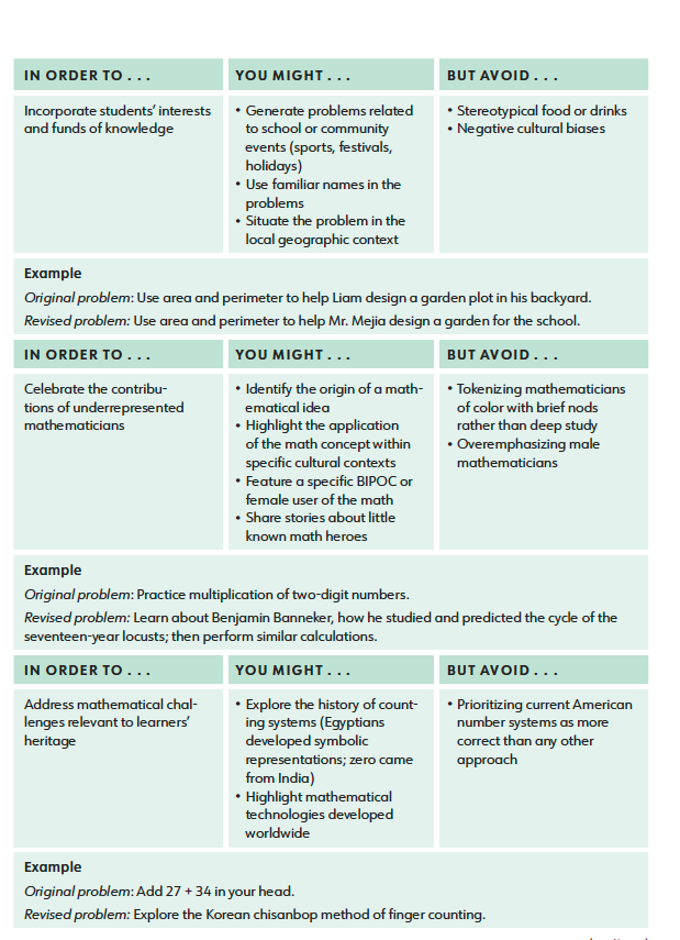
As we determine which tasks to present to students, we have opportunities to not only offer challenges but also ensure that their work is standards-driven, lifeworthy, aspirational, and culturally sustaining, perhaps not all at once, but sprinkled together with great regularity.