Adapted from Invigorating High School Math by Steve Leinwand and Eric Milou.
Math anxiety is all too real, all too common and too often, debilitating. All educators have seen students break out in a sweat, start to hyperventilate, close down or freeze up in the face of a mathematics task.
As educators working one-on-one with struggling and/or anxious students, we face an important fork in the road. Our mindsets and actions can, in the worst case, reinforce and exacerbate anxieties or in the best case, replace these anxieties with a more positive disposition toward mathematics and a palpable self-confidence. In fact, there is no better way to reinforce anxieties than with practices that present the mathematics in exactly the same way it has been done previously and created the anxieties in the first place. Ergo, we have another reason to structure and organize our teaching in ways that differ from what those we teach have experienced with mathematics.
Below, we will describe some of the symptoms of math anxiety, look at likely causes, and discuss specific strategies for helping reduce, if not entirely eliminate, these anxieties in those we teach.
Symptoms
The most obvious symptoms of math anxiety come directly from students mouths. We hear them say things like:
- “I really hate math.”
- “I just can’t remember things like that.”
- “Well you know I’m just not good in math.”
- “Fractions drive me crazy.”
- “Word problems make me feel stupid.”
- “Anything but algebra!”
But we also see those we tutor work hard to avoid math, put it off, and leave it to last. And as noted above, we need to stay attuned to the range of physical manifestations of math anxiety such as:
- Tensing up when doing a math problem or taking a test.
- Sweaty palms when confronting math.
- Withdrawal when making mistakes.
The bottom line with each of these symptoms is that they are manifestations of stress. We know that stress compromises thinking, which in turn, limits one’s ability to learn mathematics. Thus, have additional reasons to work to reduce and minimize this stress in those we teach.
Causes
There are a range of hypothesized causes of math anxiety. We present them so we are aware of the actions that induce math anxiety and then employ a set of strategies that gradually reduce, if not entirely eliminate, this math anxiety. What greater gift can we provide to those we teach?
Here is what we need to be aware of:
- The most obvious cause of math anxiety is poor performance in math. No one like to fail or feel inadequate. But when learning math and being assessed in math consistently lead to these feelings, anxiety is a natural response.
- Public embarrassment in math class when students are placed in positions of demonstrating their weaknesses can be, and often are, debilitating experiences that understandably induce withdrawal, defeatism and severe stress. Mistakes made in front of peers often result in deep feelings of inadequacy and increase the likelihood of some degree of anxiety.
- For others, the critical factor is simply the pressure of time limits in classes where speed is valued over understanding.
- Some students realize that they are getting by using memorization, but not really understanding why they are doing what they are doing. When tasks require more than just the memorization of the right procedure at the right time, anxieties start to build.
- Math anxiety can also be caused by intimidating math teachers who pride themselves in making things unnecessarily rigorous and regularly remind students “how easy this is” when it sure doesn’t feel easy to the student you tutor.
- Other students come by their anxiety environmentally thanks to parents who are only too happy to tell them that “I was never very good in math either” or even worse “I hated math too in school.” It’s amazing the damage we can inflict on young people.
- For some students, the sum total of these experiences results in the internalization of a sense that “I am just naturally bad in math” or “I’m just not a math person.
Strategies
Once these symptoms and causes are understood, we believe we are well-positioned to employ a range of strategies that help to reduce this anxiety. For example:
- The best way to reduce math anxiety is with cognitive success that in turn shifts emotions. That is, when those we teach too frequently expect to be told “no” or “wrong” or “that’s not how we do it”, learning experiences that sprinkle in the positivity of “that’s right!” or “that’s nice work!” or “I like your thinking!” can go a long way to changing self-perceptions. Even when mistakes are made or answers are wrong, we have the opportunity to point out what was correct and where there was good thinking before we focus on correcting the errors. More broadly, when over time, students see and feel their understanding growing, they are taking important steps away from math anxiety and toward self-confidence.
- It should be obvious that our feedback and encouragement must be genuine. It is incredible how quickly students pick up on fake or inappropriate praise. But when students are doing the bulk of the work and the talking, there are always opportunities for genuine praise, supportive smiles, and just a simple “Good job!"
- We often talk about “encouragement” but sometimes fall into reactions that don’t exactly encourage. Think about how frequently or infrequently you hear yourself saying things like: “I know you can work this out” or “That’s great, you’re almost there” or “Awesome, you got three of the four perfectly done.” We think of these as verbal pats on the back or sprinkling positivity dust in the domain of doing math. It seems simple, but such verbal encouragement, over time, often goes a long way.
- Remove time limits and time pressures. Sure they will eventually face timed tests, but as tutors, or primary focus much be on the mathematics, not the speed with which it is done. This obviously requires intentional patience and often uncomfortable wait time, both of which send the powerful message that “I trust you” and “When we’re together, you can take the time you need.”
- When things get tense and you feel the frustration of a tutee just not getting it, pause. Take a deep breathe together. Maybe even try to collective deep breathing. Then return to the task with a fresh approach or a different context.
- And perhaps most importantly, find ways to make it fun and build in the psychic optimism that characterizes all great teaching. Be a little silly or use crazy contexts or insert oddball names into problems. When we are having fun, we experience less stress and when we experience less stress we are better positioned to learn.
What a wonderful opportunity we have not only to enhance a student’s mathematical knowledge and self-confidence, but to also to rid them of the fears and incapacitating impact of math anxiety.
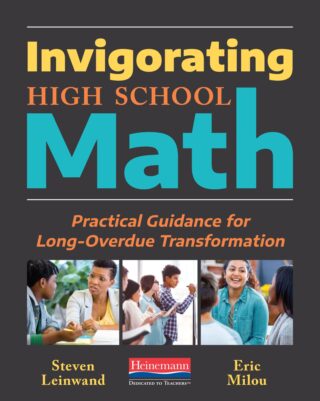
High school math is failing many students. Out-of-date and stale curricula are not only dull, but perpetuate inequity by limiting opportunities and failing to prepare a majority of students for life in the 21st century.
Invigorating High School Math is a clarion call for meaningful transformation. In this book, Steven Leinwand and Eric Milou address the most critical challenges facing high school mathematics and provide practical guidance for meeting them.