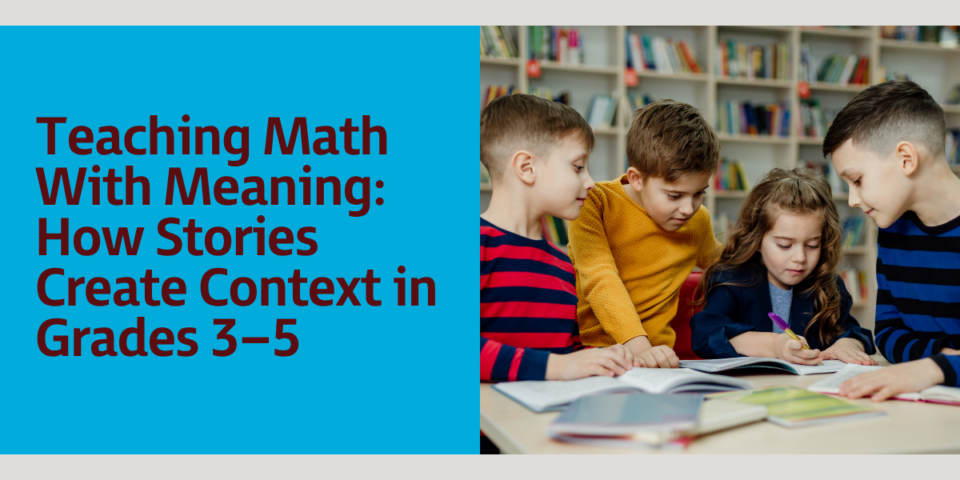
Teaching mathematics through meaningful contexts is not just a strategy for primary classrooms, it is essential for learners at every level, including the intermediate grades. As students in grades 3-5 encounter more complex concepts, there can be a tendency for instruction to shift toward rules, procedures, and memorization. Yet, without context, mathematics can quickly lose its meaning. One of the most powerful, and often underutilized, ways to provide this context is through children’s literature.
Why Context Matters in Intermediate Math
Mathematics is not a collection of isolated skills; it is a way of making sense of the world. When students explore math through real or imagined situations, they begin to see numbers, operations, and relationships as tools for understanding rather than tasks to complete. Context helps students:
- Make sense of quantities and relationships
- Visualize abstract concepts
- Apply mathematical reasoning to meaningful situations
- Retain and transfer their learning
Even in intermediate grades, students benefit from grounding their thinking in stories, scenarios, and real-world connections.
The Power of a Read-Aloud
A well-chosen read-aloud is a simple yet powerful way to launch a math lesson. Stories immediately capture students’ attention and curiosity, creating a natural entry point into mathematical thinking. Instead of starting with numbers on a page, students begin with a situation they can imagine, discuss, and explore.
Children’s books provide built-in contexts that make mathematical ideas more accessible and engaging. They allow students to see the math before they are asked to compute it.
Bringing Math Concepts to Life Through Literature
Consider how a single story can anchor a rich mathematical exploration:
- After reading The Raft by Jim LaMarche, students might explore the area of a rectangle by thinking about the size of the raft and how much space it covers.
- With Harlem Grown by Tony Hillery, students can investigate perimeter as they design rectangular garden beds and consider the lengths of the wooden planks needed.
- In Two of Everything by Lily Toy Hong, a magical doubling pot offers a perfect context for exploring multiplication patterns, as students record data and notice relationships.
- Books like Maybe Something Beautiful by F. Isabel Campoy and The Patchwork Path by Bettye Stroud offer illustrations that students might use to examine lines and angles through art and design.
- Financial literacy and decimal operations come to life through stories such as Tía Isa Wants a Car by Meg Medina and The Bagel King by Andrew Larsen, where students can explore saving and spending money.
- In Wilma Unlimited by Kathleen Krull, students may be inspired to analyze and compare decimal values through Olympic race times.
- No Small Potatoes: Junius G. Groves and His Kingdom in Kansas by Tonya Bolden provides numerical data about bushels and pounds of potatoes that supports multi-digit computation and problem solving.
- Informational texts by Steve Jenkins, such as Actual Size and Speediest!, engage students with fascinating facts that naturally lead to measurement comparisons and conversions.
Keeping Meaning at the Center
When literature is used to introduce or frame a math lesson, students are not just solving problems, they are making sense of the story situations. The numbers represent something tangible. The operations have purpose. The patterns emerge naturally.
For intermediate students, this is especially important. As math content becomes more abstract, context ensures that learning remains grounded in meaning rather than drifting into rote memorization. A thoughtfully chosen story transforms a math lesson, turning it into an engaging exploration where students think and discover.
Math by the Book
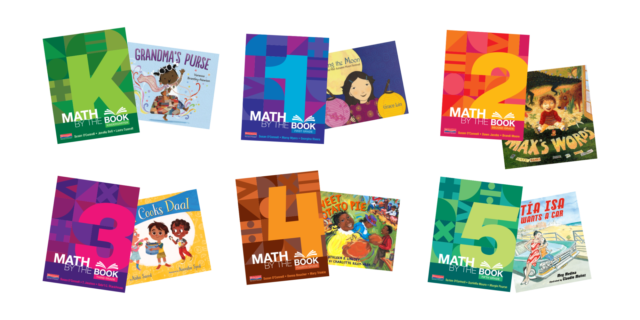
If you’re looking to bring more of these meaningful connections into your classroom, explore the Math by the Book series by Heinemann. With a dedicated book for each grade K–5, the series fully develops math topics through rich story contexts designed to engage and support student understanding. It brings math to life through literature, offering lessons, prompts, and problems that build understanding through story contexts.