Everywhere you turn right now there’s a story about artificial intelligence in schools. Some headlines promise transformation. Others warn of disruption in and beyond classrooms.
With so many concerns around AI, from privacy to personal safety to environmental impacts, educators are asking practical questions:
- Should I use AI at all?
- When does it help, and when does it get in the way?
- What does responsible use actually look like with students?
The truth is that AI is already threaded through the apps and search engines we have come to depend on, and students of all ages are likely already using AI on their own and without guidance or guardrails. While many educators are having conversations around students’ use of AI to cheat or take learning shortcuts, the bigger reality is that AI is increasingly shaping how students access information, solve problems, and make decisions. That makes it even more important for educators to help students learn how to engage with these tools, thoughtfully and responsibly.
Educators Have the Power to Shape How Students Interact with AI
It’s easy to frame AI as something happening to education. But that’s not quite right. As author and educator Meenoo Rami puts it, “Teachers, not corporations, must decide how students learn with and about AI.”
This perspective reframes the entire conversation.
AI is not a replacement. It’s not a one-size-fits-all solution. It’s a tool—one that enters a classroom already shaped by relationships, routines, and professional judgment. And like any tool, its value depends on its usefulness. Educators are in the driver’s seat here, deciding first if AI can help and then how it might be used.
Why Educators Need to Understand AI
No matter how you feel about AI personally, it’s becoming part of the world your students are growing up in. Whether you’re curious about AI, skeptical of it, or somewhere in between, understanding the rapidly evolving AI landscape has become part of the reality of teaching today.
This is not about adopting AI. It’s about understanding the landscape well enough to determine what aligns with your values and your practice and make informed decisions.
This will look different for every educator. For some, that might mean helping students understand what AI is and what it isn’t. For others, it might mean teaching students to question information, recognize limitations and inaccuracies, and think critically about when a tool is helpful and when it isn’t. For all educators, it means helping students develop the habits of mind needed to navigate a world where AI is increasingly present in visible and invisible ways.
If students are going to thrive, they need more than technical skills. They need to understand how to interact thoughtfully with increasingly powerful technologies while continuing to develop the uniquely human skills that matter most: communication, collaboration, ethical decision-making, creativity, and critical thinking. The real goal isn’t to raise a generation of expert prompt writers. It’s to help students become thoughtful decision-makers.
AI literacy is not simply learning how to use a tool. It’s learning how to ask good questions, evaluate information, recognize limitations and bias, understand different perspectives, and make choices that reflect their values.
The future will require students to be more than task completers. It will require them to be flexible thinkers, self-aware learners, and collaborative problem-solvers. They do not need to master everything right away, but they do need a strong foundation. Educators play an important role in building that foundation by helping students develop the judgment and discernment to understand and safely navigate an increasingly complex world.
Moving Beyond the Hype
Developing that kind of discernment starts with looking past the headlines and the promises that often surround AI. It feels like AI went from something being explored thoughtfully to being embedded in everything almost overnight, creating enormous pressure to react.
There’s no shortage of claims about what AI can “solve” in education. More efficient grading. Perfect lesson plans. Personalized learning at scale. In a profession where time is scarce, those promises can feel especially appealing.
But teaching is not defined by tools or efficiencies. It’s grounded in what only teachers can know: their students, their classroom environments, and their professional judgment. This is what enables you to read the room, adjust your plans mid-lesson, hold the attention of a tired group of students on a rainy Friday afternoon. It’s what keeps you focused on your students’ well-being as people as well as on their academic progress. That’s work AI cannot do.
What Teachers Know That AI Never Will
Educators bring deep expertise, lived experience, and an understanding of their students that no tool can replicate.
Educators have:
- knowledge of students’ strengths and needs
- an understanding of context and community
- instincts built through experience
Those are not replaceable. They are the foundation of teaching and the starting point for deciding when AI belongs and when it doesn’t.
Where to Start
So where do you begin when thinking about if, when, or even whether AI might fit into your work? Start with your own experience. What parts of teaching give you energy, and what parts tend to drain it? You may find there are parts of the work you want to stay close to such as responding to students, differentiating instruction, and designing meaningful learning experiences. That’s where your expertise matters most.
But there may also be moments where extra support could help. AI can help educators generate ideas, organize information, and provide starting points. It can:
- help draft a newsletter or email to families and caregivers
- provide a starting point for lesson planning or unit pacing
- suggest classroom routines, generate ideas for recognizing students’ achievements, or brainstorm response to common classroom challenges
Most importantly, trust your instincts. You don’t need to know everything about AI to begin. It starts with you, the educator. You decide when and where it belongs—and when and where it does not.
The Throughline: Teacher Agency
AI will continue to evolve. New tools will emerge. New debates will surface. New expectations will take shape.
But one thing remains constant:
The future of AI in education will not be decided by technology companies or headlines. It will be shaped, day by day, in classrooms, through the choices educators make. Because in the end, it’s not about AI. It’s about the educator making thoughtful decisions for their students, for their classroom, and for the kind of learning that matters.
AI can support educators in meaningful ways. It can save time, reduce decision fatigue, and offer a starting point when energy is low. But the most important work remains in the hands of educators: building relationships, exercising professional judgment, and making thoughtful decisions in service of students.
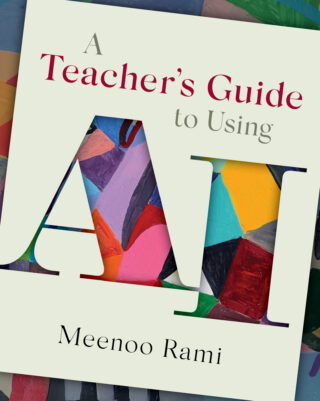
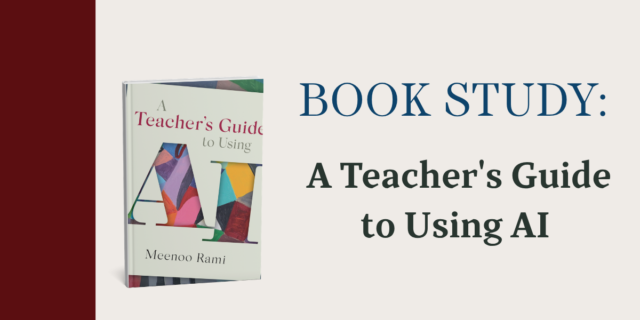
A Teacher’s Guide to Using AI offers a starting point—one that cuts through the hype and brings the conversation back to where it belongs: the teacher. Whether you’re exploring AI on your own, discussing it with colleagues, or learning alongside a PLC, the accompanying Book Study Guide offers reflection questions and discussion prompts designed to deepen professional learning and conversation around first understanding and then using AI in education.