Adapted from Integrating Technology by Sarah Gilmore and Katierose Deos
Moving toward planning for and implementing technology integration in your classroom means moving away from technology as an add-on and toward technology as an embedded and purposeful component of learning and teaching. To support teachers in doing this, we have created the Intechgrate Approach to make the process of planning for, scaffolding, and realizing effective technology integration clearer and more articulated.
The six steps outlined in the Intechgrate Approach apply to all levels of integration, all levels of teacher competency, and all levels of resources. As you read this you may think that it seems like a lot to think about, and in the beginning it can be! But just as everyday teaching strategies and planning have become second nature to you, these steps will become simply a part of how you plan and teach with the tools available to you and your students. Most importantly, by training yourself to think about and plan for technology integration in this way, you will ensure that when you do use technology in your classroom it will benefit your students and support their learning.
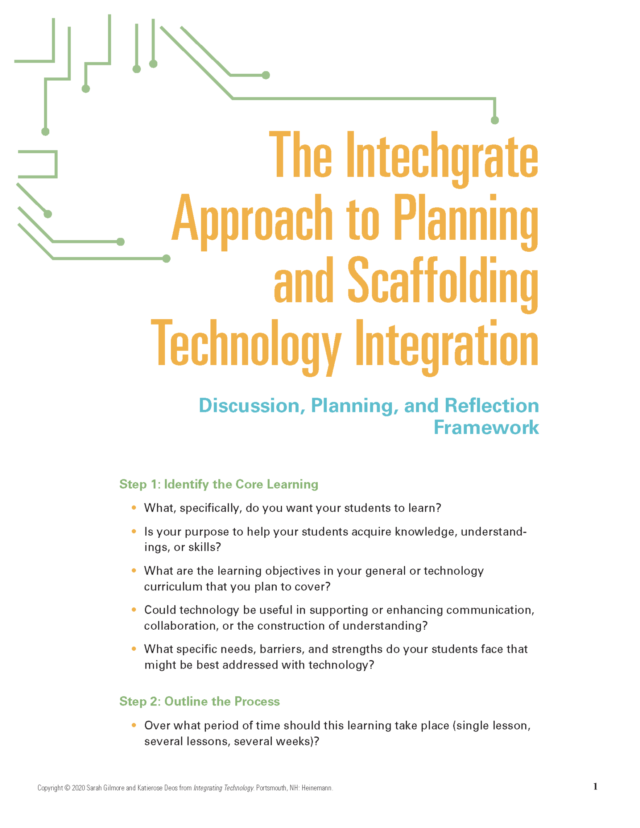
Step 1: Identify the Core Learning
- What, specifically, do you want your students to learn?
- Is your purpose to help your students acquire knowledge, understandings, or skills?
- What are the learning objectives in your general or technology curriculum that you plan to cover?
- Could technology be useful in supporting or enhancing communication, collaboration, or the construction of understanding?
- What specific needs, barriers, and strengths do your students face that might be best addressed with technology?
Step 2: Outline the Process
- Over what period of time should this learning take place (single lesson, several lessons, several weeks)?
- How could you find out at the end of the learning process whether your students have learned what you wanted them to learn?
- Is the core learning best assessed in terms of the process of learning or the product of learning?
- What learning engagements would enable your students to achieve the planned core learning?
- What technology tools and approaches could you use to enhance these learning engagements or the learning process?
Step 3: Plan and Scaffold
- What scaffolding and prior knowledge will your students need to be successful in meeting the core learning objective(s)?
- How would you normally plan to teach this core learning (i.e., without technology)?
- How will your process need to evolve to reflect the integration of technology?
- What additional technology-specific knowledge, skills, or understand-ings will your students need to be able to use the technology tool(s) you have chosen?
- How will you assess what prior technology knowledge, understanding, or skills your students already have?
- How could you introduce and scaffold the development of technology- specific learning?
- How can you give your students an opportunity to explore the technology in a low-stakes capacity before engaging in the core learning?
Step 4: Troubleshoot and Try It Out
- Which portions of the planned learning do you feel least confident about?
- What technology-specific problems could you imagine occurring?
- What steps can you take to try your technology ahead of time?
- Do you have a backup plan in place in case the technology doesn’t work?
- What are your expectations for student behavior with the technology during the learning process?
- What potential exists for misuse of the technology?
Step 5: Live the Learning
- What observations could you make during the learning to inform your reflection later?
- How will you communicate your expectations for behavior to the students?
- How could you get help or support during the learning if you face technology issues?
Step 6: Reflect
- To what extent was the planned process successful in addressing the stated core learning?
- To what extent was technology helpful for students in meeting the core learning?
- What further scaffolding would students need in the future to be successful in (1) the core learning and (2) the use of technology?
- Was the technology integration worthwhile in terms of teacher and student focus versus outcome?
Download the outline for discussion, planning, and reflection.
There is no one-size-fits-all when it comes to technology integration. Wherever you are in the world and whatever your role is, you can harness the power of technology to make teaching and learning more meaningful, relevant, and effective. Let Integrating Technology be your guide and start making effective technology integration a reality in your school community.