Adapted from Integrating Technology by Sarah Gilmore and Katierose Deos.
If you are in a position to have more ownership over the development, revision, or design of a technology curriculum specifically for your context (whether that context is a district, a school, or your own classroom), then you are in a wonderful position to articulate one that supports an integrated approach to learning and teaching. However, like many wonderful opportunities, it can also be overwhelming. To help guide you through the process, we outline our suggested phases of designing and developing an integration-focused technology curriculum. Bear in mind this is not a prescriptive process: you will need to pick and choose elements that make sense in your context and adapt them to suit your specific need.
Within an integrated technology curriculum, the focus shifts away from teaching skills for skills’ sake to teaching students to apply skills in a broader context. Instead of asking students to learn to type, save documents, or code for the explicit purpose of knowing how to do those things, we structure the curriculum in such a way that these kinds of skills are primarily developed as a consequence of using technology in context. We start by asking a broader question about what and how we want our students to learn in general and then consider which technology skills will be most valuable for our students in achieving that goal.
When designing an integrated technology curriculum, begin with broader concepts and purposes such as these, which you believe are most valuable to learning in general and support the broader curriculum, and then consider which skills students will need to meet them.
How you structure this will depend a great deal on the specifics of your context. In some countries, there are specific technology tools and skills that must be taught or that cannot be used, depending on government guidelines. In some schools, programs such as the International Baccalaureate (IB) suggest to a certain degree how such a curriculum should be structured (e.g., under the six Primary Years Programme Information Communication Technology Skills). Beyond such constraints and guidelines, we would recommend structuring your curriculum in the same way as most written curricula are structured.
- Learning goals: These are broad statements about the intended learning that should take place.
- Learning objectives: These are narrower statements that break down what the students should specifically learn to do in order to meet the learning goal.
- Skills and competencies: These are the skills that the students will need to develop in order to be able to meet the learning objective.
- Application: What should teachers do in the context of the wider curriculum that will enable them to teach these goals, objectives, and skills?
To provide you with an example of how this might look, we have drawn from the 2016 ISTE (International Society for Technology in Education) student standards:
- empowered learner
- digital citizen
- knowledge constructor
- innovative designer
- computational thinker
- creative communicator
- global collaborator
As you can see, the intended learning is already framed to support an integrated approach to technology. Using the ISTE standards for students as learning goals and objectives, we can consider which technology-specific and general skills students might need to develop in order to be able to achieve those goals. Following are a few examples.
Knowledge Constructor
- ISTE learning goal: “Students critically curate a variety of resources using digital tools to construct knowledge, produce creative artifacts and make meaningful learning experiences for themselves and others.”
- ISTE learning objective: “3a: Students plan and employ effective research strategies to locate information and other resources for their intellectual or creative pursuits.”
Possible supporting skills and competencies:
- Identify keywords and use them to search for relevant digital resources.
- Skim and scan nonfiction texts (on- and offline) to identify main points.
- Take and organize notes when carrying out research, using a variety of tools and approaches.
- Understand and utilize navigational features on websites and digital tools (menus, navigation arrows, hyperlinks) to find and access information.
Possible integrated applications:
- Carry out research (independent, supported, or guided, depending on student development) to inform learning during social studies lessons or projects.
- Practice and apply nonfiction text reading skills and note-taking skills during research or as part of guided reading or language lessons.
Creative Communicator
- ISTE learning goal: “Students communicate clearly and express themselves creatively for a variety of purposes using the platforms, tools, styles, formats and digital media appropriate to their goals.”
- ISTE learning objectives: “6b: Students create original works or responsibly repurpose or remix digital resources into new creations” and “6c: Students communicate complex ideas clearly and effectively by creating or using a variety of digital objects such as visualizations, models or simulations.”
Possible supporting skills and competencies:
- Mouse skills (clicking, dragging, etc.)
- Typing skills
- App- or program-specific skills, such as animation or movie creation
- Planning and organizing ideas to create solutions to problems
- Coding skills (from algorithmic thinking, to dragging and dropping, to advanced programing languages, iterating and reiterating, and debugging)
- Aesthetic design skills
Possible integrated applications:
- Create digital stories with illustrations based on original or existing ideas, depending on age and development.
- Create a digital product, such as an animation, a movie, or a podcast, to communicate knowledge and ideas (e.g., as a final, summative record of learning).
- Create a website or digital book to record ongoing learning.
The skills you choose to include in your technology integration curriculum, as well as which structure you choose for learning goals and learning objectives, must depend on the unique circumstances of your students and your context. You might choose to refer to ISTE, the IB, or any number of other international curricula and approaches in gathering together these specifics.
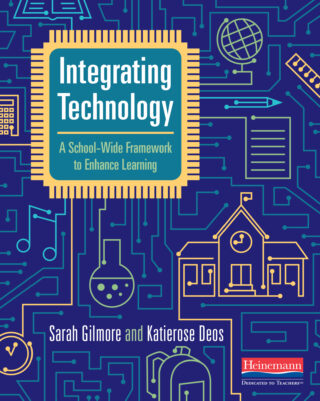
There is no one-size-fits-all when it comes to technology integration. Wherever you are in the world and whatever your role is, you can harness the power of technology to make teaching and learning more meaningful, relevant, and effective. Let Integrating Technology be your guide and start making effective technology integration a reality in your school community.