by R. Joseph Rodríguez, author of Youth Scribes.
“[I]f I’m lucky, if I’m quiet enough, lines of poems I love start to move through me. They come to me as if through a necessary beckoning.” —Ada Limón, from Against Breaking: On the Power of Poetry (2026, 5) |
Our students carry poems.
Their poems take form in our classrooms when we invite our students to write and also write with them. Every poem reveals our imaginings and musings, which we can bring to our lives through verse.
In a sense, every act of writing requires an invitation that appears in the form of self-determination and from another person or source—one’s very own guide or teacher. You.
In the book A Poem Traveled Down My Arm: Poems and Drawings (2017), Alice Walker explains her reticence to autographing her own books for readers that total more than 1 million signed copies.
And after more than thirty years of not writing, Walker explains that she moved away from signing her name and began “drawing things instead.” She adds, “[A]s if completely over the mundane task of writing my name, we, my pen and I, began to write poems” (2017, 2). Imagine!
Walker’s use of the pronoun we becomes instructive. She considers the sources of creativity as a poet who creates. In fact, I remember all the people involved in my becoming a teacher, writer, and poet—and also remaining a learner. Their interceding and encouragement were a boon for my development and growth.
The community of people I describe were also full of imagination, wonderment, and ultimately creativity, which was then delivered to an audience before them that included me.
I tell my students about the origin of the poem “heartdrumming,” which they read and then create a dialogue with the poem as interpreters and modern youth scribes. I believe, “Teacher scribes can make a mark beside their students,” as I explain in my book Youth Scribes: Teaching a Love of Writing (2025, xix).

Early one morning in 2022 and during the COVID-19 pandemic, I heard a drumbeat that came from a song blaring from a speeding car in our neighborhood. I considered the motorist’s actions as decisions that moved me to listen and write.
The moment seemed ripe for a poem to unfold and take shape. In fact, the poem traveled to me through a motorist, stereo, and vehicle.
Overall, the poem came at full force and landed on my keyboard lap like a vehicular lyric and visually in this form:
happen
you to
if see
a
heart
in
this
poem
then
listen
to the
beating
half in
yours
too
k? (Pitre, 2023, 51)
My adolescent students’ filter goes missing sometimes that what they reveal is both organic and grand. That was the case when CJ declared, “This ain’t no poem! It looks strange to be a poem actually.”
Asiel retorted, “It’s a poem. Just take a look. It makes you slow down and notice all that’s in it, and it’s not just words. Can’t you see half a heart, an ear, a butterfly’s wing, or anything else?” Both CJ and Asiel became interpreters of the poem “heartdrumming,” and Asiel’s annotations and artistic response appears below:
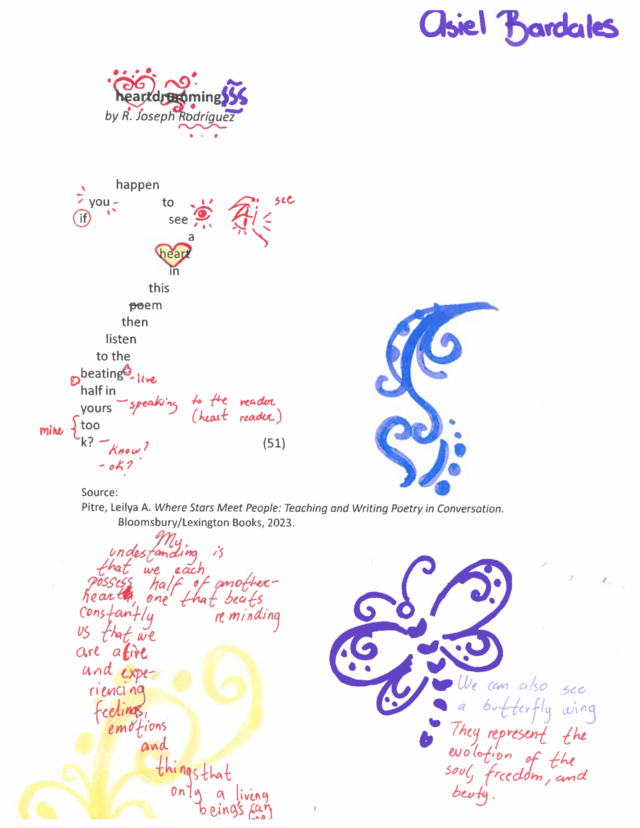
A poem can reveal itself to us when we accept an invitation, and this often happens when classroom teachers beckon their students to a gallery of poems and to begin the conversation. Among their classmates, students’ candidly deliberate and share their experiences that complement the poem. Their own journey gets interpreted via a poem dialogue with their peers.
Most recently, in Against Breaking: On the Power of Poetry (2026), Ada Limón reveals, “[A]ny time I begin to write anything these days, my whole life flashes before my eyes. I ask myself, Do I want to break something, or do I want to mend something? Or simply try to carve out a small place to breathe? I want, and have always wanted, only to make something true” (3).
Like a poem, truth unfurls itself when we look inward and seek sources to name what is before us as evidence or fact. But our imagination also soars through words and wonder found in verse.
What travels with us is a poem when we slow down to notice, reflect, and self-examine. Whether it’s down our arms, from a vehicle passing by, or a concrete form, poems accompany us in our travels and journeys.
David J. Kelly explains, “Anyone can come up with enough words, but the poet’s job is about writing the right ones. The right words will change lives, making people see the world somewhat differently than they saw it just a few minutes earlier” (2004, xi).
May more poems beckon and move you to see more deeply. And may the Muses and sails of poetry be at your side as you read and write verses with your students.
Read on this April 2026 and forward!
References
Kelly, David J. 2004. Foreword to Poetry for Students: Presenting Analysis, Context, and Criticism on Commonly Studied Poetry, vol. 19, edited by David Galens, ix-x. Detroit: Thomson Gale.
Limón, Ada. 2026. Against Breaking: On the Power of Poetry. New York: Scribner.
Pitre, Leilya A. 2023. Where Stars Meet People: Teaching and Writing Poetry in Conversation. New York: Bloomsbury.
Rodríguez, R. Joseph. 2025. Youth Scribes: Teaching a Love of Writing. Portsmouth, NH: Heinemann.
Walker, Alice. 2017. A Poem Traveled Down My Arm: Poems and Drawings. New York: Random House.
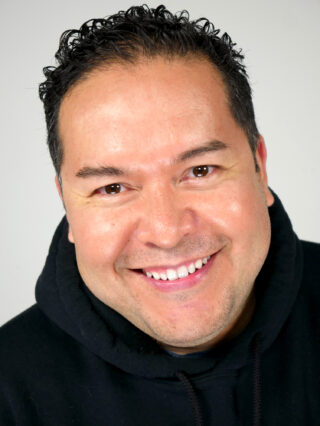
R. Joseph Rodríguez is the author of Youth Scribes: Teaching a Love of Writing (Heinemann, 2025), among other titles, as well as research articles and narrative poems. He teaches at an early college, public high school. Joseph and his students read banned, challenged, censored, and confiscated books, and they practice academic, creative, and technical writing as modern scribes. He lives and teaches in Austin and Fredericksburg, Texas. Visit him online at: www.rjrodriguez.com.