Adapted from A Teacher’s Guide to Using AI by Meenoo Rami.
Many young people encounter AI as a means of finishing their work or finding answers, but that kind of surface-level use limits both curiosity and growth. Wharton Teaching Your Students to Use AI professors Ethan Mollick and Lilach Mollick call this form of using AI a tool. They go on to outline six additional roles AI can play in student learning: a tutor (providing direct, interactive instruction), a coach (providing reflection on a recent experience to promote metacognition), a mentor (providing feedback), a teammate (either helping team members recognize and leverage each other’s strengths or playing devil’s advocate to help teams improve their plans), a simulator (providing a role-play partner), and a student (providing an opportunity for the user to act as teacher, a role that can help users solidify their own understanding of a topic) (Mollick and Mollick 2023). The Mollicks acknowledge that none of these models are perfect. The limitations of today’s AI technology means that they may include errors, for example, but they can still be helpful tools.
When you help students see AI as flexible and context-dependent, you set the stage for thoughtful, purposeful engagement. When your students start to see AI as something they can shape, challenge, and learn from, they begin to understand that they are the ones in control. You are not just teaching them how to use AI. You are helping them grow into learners who can navigate uncertainty, adapt to new tools, and stay rooted in human insight and integrity. You’re inviting your students in the safety of your classroom to try out the variety of roles AI can play in their learning experiences in and out of the classroom.
To help your students consider fresh ways in which AI can help them, you might use these approaches:
- Model how students can use AI in a role other than as a tool. As part of a unit review, you might prompt a chatbot to act as a student, asking your real-life students to help you teach the bot about the concepts from the unit. When preparing students for a debate, you might have the chatbot act as a simulator in the role of students’ debate opponents.
- Remind students to maintain a healthy skepticism regarding AI’s responses. It’s one thing to be skeptical of AI in the abstract. It’s something else to be skeptical of AI when it’s role-playing a friendly peer or a helpful mentor. Lean on the understandings about AI addressed throughout the book to remind students that AI truly is just a machine, no matter what role it is playing.
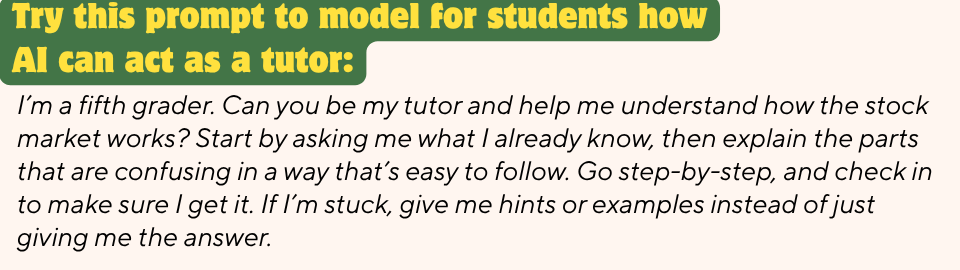
Experiment with This Idea
Source
Mollick, Ethan, and Lilach Mollick. 2023. “Assigning AI: Seven Approaches for Students, with Prompts.” Sept. 23, revised Sept. 26. The Wharton School Research Paper Series. SSRN: https://ssrn.com/abstract=4475995.
A Teacher’s Guide to Using AI is an essential companion for educators navigating the rapidly evolving world of artificial intelligence in schools. Meenoo Rami, a former classroom teacher and longtime advocate and builder of thoughtful technology in education, offers clear, specific, actionable guidance to help educators understand, incorporate, and make sense of AI’s role in the classroom, including:
- practical strategies for using AI in your own work to save time, personalize instruction, communicate with caregivers, and spark creativity
- integrating AI into lesson planning, creating and refining assignments, planning curricula, analyzing student data, and providing feedback
- guidance for teaching students about AI’s capabilities, limitations, ethical considerations, and potential risks as well as how it can supercharge their learning and agency

When I was in the classroom, I used DonorsChoose to raise money for books for my classroom library. I know what it feels like to want the right books in students' hands and not always have the budget to amke that happen. I also know what i means when people decide your students, your classroom, and your work are worth backing.
This is part of why this feels meaningful to me.
DonorsChoose helps eligible public school educators request support for their classrooms and schools, including books and professional learning materials. I’m glad to share that A Teacher’s Guide to Using AI can now be requested through DonorsChoose.
I wrote this book for educators who are trying to think clearly, protect what matters, and make thoughtful decisions in a moment of real change. My goal was to create something practical, honest, and grounded in a deep belief in teachers and students. My hope is that this gives educators one more way to bring the book into their work. Maybe that means requesting a copy for yourself. Maybe it means using it in a team book study, a coaching cycle, or a wider professional learning conversation at your school.
Teachers do not need more hype. They need support. They need practical guidance they can actually use. They need room to exercise their judgment.
I’m grateful that DonorsChoose can be one more path for getting this book into the hands of educators who want that kind of support.