Adapted from Difference is Not Deficit by Dr. Bibi Pirayesh.
Most classroom teachers spend a lot of time asking students to talk:
- Turn and talks.
- Small- group discussions.
- Socratic seminars.
- Structured academic talks.
These moments are meant to build critical thinking and student voice. And yet, what looks like discussion often operates more like debate, complete with winners, losers, and unspoken rules about whose voice carries the most weight.
The same few students dominate the conversation. Students rush to defend a position rather than listen to one another. The goal becomes sounding “right” instead of thinking together.
This distinction matters, not because teachers are doing something wrong, but because the structures we inherit in schools often reward argument over understanding. When we pause to ask what we are actually teaching students to do when they talk together, we open the door to a different kind of classroom culture. One rooted in listening, collective meaning-making, and connection.
Clarifying the difference between debate and true discussion helps make that shift visible.
The fact is, our schooling values debate over true discussion. In a discussion, all parties share their perspective. Proposing new ideas is welcomed and even encouraged. The goal is to learn from each other so that by the end, everyone has moved closer to each other. This is very different from a debate, in which opposing arguments are put forth in a formalized, specific way using particular rules. The understanding is that one argument will be made over another and at the end a decision carried. There is no thinking together, no group process, just one individual making points, as if stating a point will make it true. Similarly, there is no understanding that each debater’s point of view is going to be colored by their unique lens. Whoever makes the “stronger” argument, or the “better” point, takes the cake. How “better” is decided is itself often a reflection of muscle more than understanding or truth or justice. The question is not about finding equitable solutions that work for everybody but about whose argument can win.
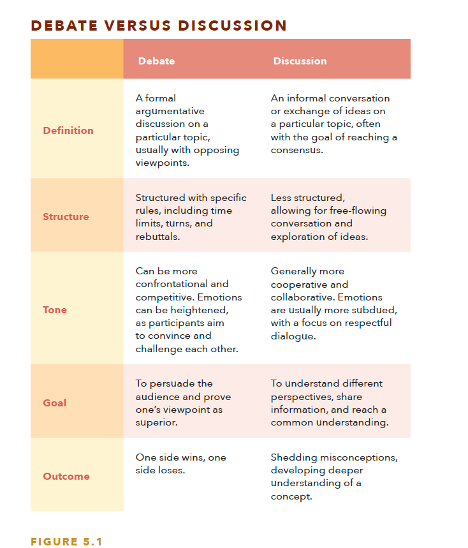
For all the essay and debate topics that have been assigned over decades of American education, for all the thousands, millions even, of students who have addressed them, can we honestly say that we have gotten closer to some truth or justice? The fact is that truth and justice are far more rhizomatic. They are never contained in one point of view. Deep down we know this. We attempt to accommodate it by teaching students to also present the counterargument, as if creating this duality is somehow teaching empathy by getting students to put themselves in each other’s shoes. In reality, it is simply using the same techniques to argue a different point. Students are tasked with making an argument using rationality, logic, and evidence (observable data). As a result, students become skilled in the art of distancing, learning not how to listen and cooperate, but how to outmaneuver. This teaching then becomes less about learning how to hold multiple truths and more about proving one right and the other wrong. In the name of intellectual rigor, we reward domination disguised as dialogue and in doing this we not only force students to let go of what comes naturally to them—connecting to others—we also teach them that what is good, natural, and valuable is decimating the other.
Discussion Protocols
How then do we create a culture of true connection? There are three things I have found to be important when it comes to promoting discussion, community building, and collective problem solving with students. They may seem simple, but they are usually what we don’t have and what we need to be intentional about. They are time, attention, and space.
It is only when we give our time and attention to something and create space for it that it actually happens. In my experience, it is good to be intentional with all three. In my work with parents, I make it a point to give fifty minutes of our hour-long session to students and require the parents to do a check-in for the last ten minutes. This is every time, and I take that time seriously. If a parent is unable to do it, I ask that they make up the time.
When it comes to accessing teachers and other professionals in a child’s life, it is not as easy to find the time. Here, I create the space instead. At the end of any meeting about a student, I create a shared Google Docs™ (or other space) in which I ask teachers and all others involved to do a weekly check-in. Every week, every individual involved in the student’s care—teachers, aides, counselors, and parents—write a brief reflective entry about how the student is doing. Everything from academics, to social-emotional challenges, to successes, to failures can be written here, and we are able to reply to each other’s comments. The Google Doc therefore serves as a living document in which we can communicate, and I make a point to mention it in any subsequent meeting. Interestingly, teachers and others who are not able to keep up with this task (after they have agreed to do so) often become more sympathetic to students struggling to follow their directions. This method doesn’t work at every school (many don’t allow it) or with every teacher (many truly forget or don’t have the time); yet just the attempt seems to somehow remind everyone involved of the importance of communication and our responsibility as members of a community surrounding a student.
Finally, as I am a big believer in allowing room for venting and even professional “gossip,” I make it a rule to dedicate time and space for team members (including students) to share frustrations, air grievances, and process emotions around a case. So much conflict is avoided when we allow people to decompress, commiserate, and vent frustrations before diving back into problem solving. These are just some basic examples of ways to be intentional about giving time, space, and attention to mutual communication and community building.