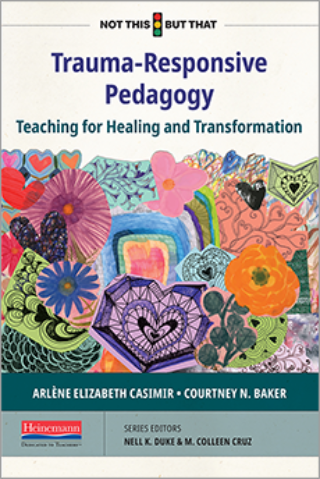
Adapted from Trauma-Responsive Pedagogy by Arlène Elizabeth Casimir and Courtney N. Baker
Child development is typically explained with a stage theory, which means that, in general, it proceeds in order, over time, and that stages typically cannot be skipped. The stages are predictably pinned to children’s ages, such that it is reasonable to expect a seven-year-old to possess the skills typical of that age. Educators tend to understand typical child development well. They usually took at least one child development course as part of their training, and they frequently employ age-normed screenings as part of their routine benchmarking or special education processes at school. They are experts not only at understanding certain areas of child development relevant to learning, such as reading or math skills, but also at using scaffolding within the zone of proximal development (Vygotsky et al. 1994) to help children continue to grow those skills. Finally, educators work with large numbers of children across their careers, and they watch those children develop skills over the course of the academic year, a process that is particularly notable for educators teaching students in early childhood and during puberty. Taken together, educators tend to have fairly reliable “internal norms” for typical child development milestones.
However, there are a few important take-home points about child development that are critical to understand for teachers interested in trauma-responsive teaching.
1. Students may have lagging skills or skills that are developmentally younger than their chronological age. There are many reasons why this might occur, including having experienced ACEs (Adverse Childhood Experiences) and trauma (Greene and Ablon 2006). Though the full chronicling of what lagging skills might look like in comparison to typical development is beyond the scope of this book, with regard to social, emotional, and behavioral skills, these children typically look immature. Greene and Ablon (2006) catalog that, in comparison to their peers, they:
- seem less able to cope with routine peer interactions or classroom expectations;
- have poorer impulse control, ability to delay gratification, and executive functioning skills;
- experience poorer emotion regulation and more frequent or intense uncomfortable feelings, including worry, anger, sadness, guilt, and shame;
- appear more vigilant or fearful, like they expect bad things to happen;
- are cognitively inflexible, with particular challenges with changes to routines, ambiguity, transitions, abstract concepts, and perspective taking;
- have lower self-esteem, less initiative or persistence, and more challenges forming a positive identity; and
- struggle with relationships stemming from challenges with attachment and/or social skills
Children need to learn these skills, and in chronological order, so that their developmental age can catch up to their chronological age. For example, if a student is seven years old, but their math skill is comparable to that of a five-year-old, then math instruction must generally begin at the five-year-old level and proceed forward, in order. This is not surprising to educators. However, sub in the word social or emotional skill instead of math skill, and educators have a harder time imagining that they might need to scaffold developmentally appropriate learning of the social or emotional skills of a five-year-old in their classrooms of seven-year-olds. In the context of the many stressors of the classroom, educators can even make the mistake of seeing the child with lagging skills as misbehaving intentionally, being manipulative, or not trying hard enough.
2. Children’s development includes many facets, such as physical, cognitive, social, and emotional development. Though development typically proceeds through stages in order, a child’s developmental profile may be “rugged,” meaning that the student can have average or above-average verbal and motor skills but still have lagging social or emotional skills. It is critically important that educators approach each child from a lens of that child’s strengths, resisting defining the child only by areas in which there is a need for developmental acceleration. Unfortunately, education reform has pushed classroom education for early grades toward a model more appropriate for more advanced developmental levels, such as requiring kindergarteners to sit still at desks for long periods of time and take standardized tests without interacting with peers or teachers. Even when teachers are aware of the developmental mismatch in their classrooms, it can sometimes be a challenge to push back against school, district, or policy requirements that are developmentally inappropriate.
3. Children who are physically larger for their age are perceived as more mature, and Black boys, in particular, are overly noticed for and misperceived as hostile and misbehaving when those behaviors are either minor or normative (Giordano et al. 2020). Teachers have been shown to hold higher academic expectations for White students in comparison with Black and Latinx students (Tenenbaum and Ruck 2007). At times, the pendulum can swing even farther—not only are the adults less likely to provide supports to Black and brown students, but they are also more likely to engage in negative talk or harsh interactions. Additionally, teachers are more likely to underestimate the academic abilities of children with lagging developmental skills related to both social skills and attention—arguably the children who need the most care and attention—and those lowered expectations are linked with less academic growth over the school year (Baker et al. 2015). If a student is perceived as more mature or more threatening because of their size or skin color, adults may be less likely to provide the scaffolding they need to cope with and learn from the situation. In each of these contexts, not only will the student struggle to learn the lagging skill, but it will also be an unrewarding and challenging situation for everyone involved.
Adults tend to notice lagging skills when behaviors are more disruptive. For example, children with lagging skills who are quiet and more withdrawn (often girls), as opposed to throwing tables, can go unnoticed. Without universal screening (the equivalent of benchmarking for social and emotional skills), these students can slip through the cracks (Pickford et al. 2021). If adults don’t notice their lagging skills these children are less likely to be referred to the special education evaluation process or to external resources and are therefore less likely to get early and effective support.
Over- and undernoticing are two sides of the same automatic human cognitive process, which takes these particular forms due to the current norms of society. Every human being possesses implicit social attitudes, so it is not possible to “erase” them; rather, the goal is to become aware of them and work actively against their assumptions. Several evidence-based approaches to enhance equity exist, such as engaging in professional development and self-reflection about internalized bias, using normed instruments whenever possible, and disaggregating data by sociodemographic characteristic to check for patterns. Trauma-informed approaches also enhance equity by training educators to ask themselves questions about a student’s behavior—such as “What might have happened to this student?” or “How might this behavior serve an adaptive purpose for this student?”—before reacting to it with, for example, punitive or exclusionary discipline.
The final take-home point related to child development is that all humans need to learn social, emotional, and behavioral skills just like they learn math or reading skills. Humans are lucky in that they essentially do not have a critical period or a point at which teaching a new skill becomes impossible. It is almost never too late for humans to develop their lagging skills, though earlier intervention has the ability to impact the child’s developmental trajectory in a more significant way. Nonetheless, teachers often feel underequipped to handle these types of issues in the classroom, in part because their pre-service and in-service training typically does not focus on it.
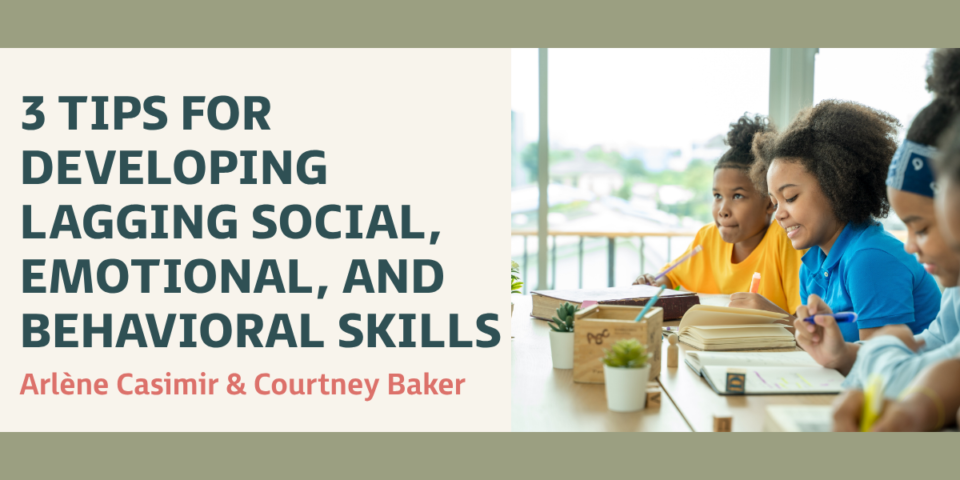
I deeply believe, however, that teachers are actually the perfect individuals to tackle this challenge of developing lagging skills. Teachers know better than anyone else how to teach a skill. With the right tools and a shift in their mindsets, they can apply that depth of knowledge to the teaching of social, emotional, and behavioral skills. Just like teaching academic skills, the process is simple: provide explicit instruction, model, practice, coach, and reward the use of the skills. Like all skills, consistent practice is the best way to learn them. For example, skills related to following teacher instructions or coping with stress by deep breathing can be directly taught in groups or individually, modeled by the teacher, practiced routinely in the classroom until mastery is achieved, coached if additional supports are needed, and rewarded using tangible (e.g., a sticker chart) or relationship-focused (e.g., praise) ways, all in a consistent manner over time.